What Strategies Can Help You Budget on a Variable Income

Budgeting on a variable income works by anchoring your plan to your lowest-earning month, not your average. You also split your spending into must-pay essentials and everything else before your income moves, so rent, utilities, and food are covered no matter how the month turns out. A budget built this way stays steady even when your paychecks don’t.
Key Takeaways
Budget around your lowest month. Averages hide how bad a lean month really gets.
Fund essentials first. Housing, utilities, minimum debt payments, insurance, and groceries come before anything else.
Keep two cushions. A smoothing buffer covers lean months. An emergency fund covers true emergencies.
Check in weekly. A monthly review finds shortfalls too late.
Apply 50/30/20 to your floor, not your last paycheck.
Move 20-30% of every payment into a tax account the day it lands.
Pay yourself a fixed salary from a holding account so irregular income feels like a paycheck.
What Is a Variable Income?
A variable income is money that changes from month to month in amount, timing, or both. Freelance work, commissions, gig platforms, seasonal jobs, and business ownership all fit.
It’s more common than most people think. An Experian survey from May 2026 found that more than 80% of gig workers have dealt with unpredictable income, and nearly 3 in 4 see swings of 25% or more.
That’s the real problem. A regular paycheck lets you plan ahead. An irregular one forces you to guess. The strategies below take the guessing out.
7 Strategies That Can Help You Budget on a Variable Income
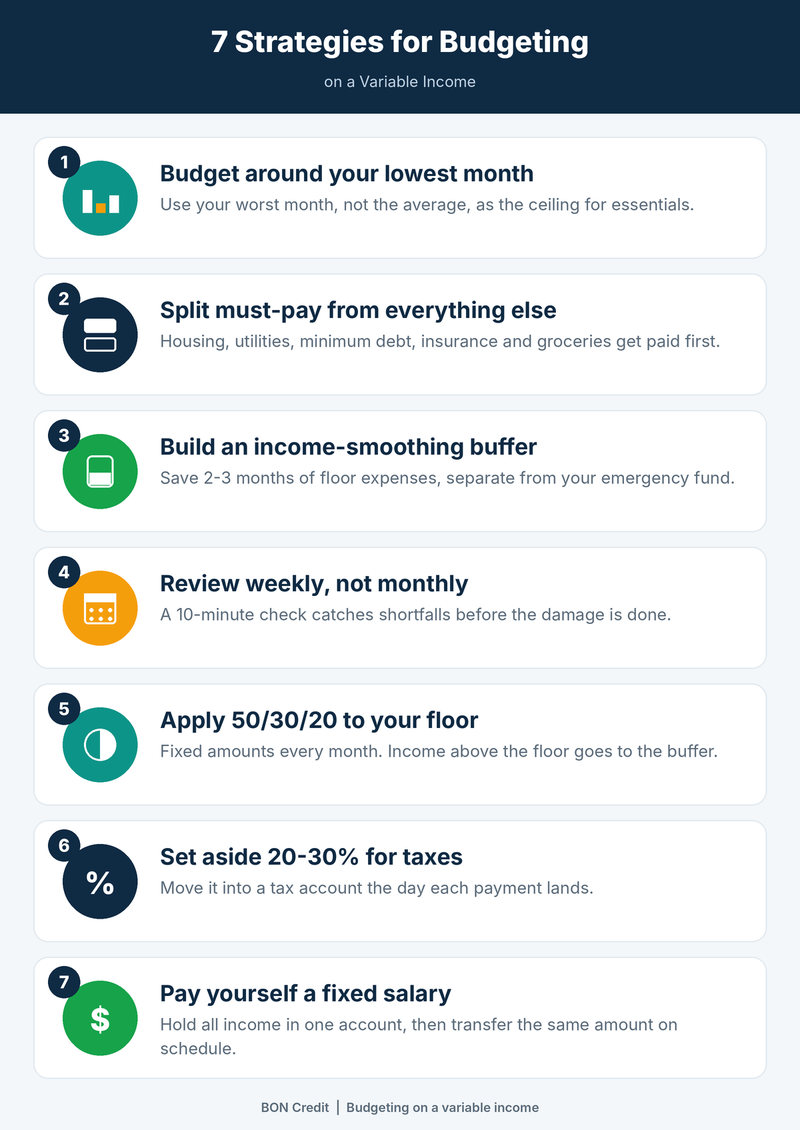
1. Why Should You Budget Around Your Lowest-Earning Month, Not Your Average?
Because the average hides your worst month. Averaging feels logical, but it smooths over exactly the month that causes trouble.
Here is the method:
Pull 6 to 12 months of income history.
Find the single lowest month.
Treat that number as the ceiling every essential bill must fit inside.
Your bank statements, invoicing software, or a payment platform’s export feature will give you the numbers.
If you’re new and have fewer than 6 months of history, use the lowest month you have. Revisit it every quarter as more data comes in.
The payoff is simple. Once your essentials fit inside that floor, every month at or above it becomes a surplus month instead of a shortfall risk.
2. How Do You Separate Must-Pay Bills From Everything Else?
Sort every expense into two tiers, and fund tier one completely before anything touches tier two.
Tier one (must-pay): housing, utilities, minimum debt payments, insurance, and groceries. Missing these has real consequences, like eviction, disconnection, or credit damage. Late payments also hurt your payment history, the biggest factor in most credit scores.
Tier two (discretionary): dining out, subscriptions, entertainment, and upgrades.
The rule is firm. No partial funding of both tiers. Tier one gets paid in full, every month, first.
One nuance: minimum debt payments belong in tier one. Extra payments to pay debt off faster belong in tier two. Missing a minimum has consequences. A slower payoff doesn’t.
3. Why Do You Need an Income-Smoothing Buffer Separate From Your Emergency Fund?
Because they solve two different problems. A smoothing buffer bridges lean months. An emergency fund is for true emergencies like a medical bill or a major car repair.
Many articles use the two terms as if they mean the same thing. They don’t, and mixing them up is how people drain their safety net on an ordinary slow month.
Here’s how the buffer works:
In a high-income month, the surplus above your floor goes into the buffer.
In a lean month, you cover the gap from the buffer instead of a credit card.
The target size is 2 to 3 months of floor expenses. It’s smaller than a full emergency fund because you expect to draw it down and refill it.
Check the balance during your weekly review so it never runs dry without you noticing. If you don’t have a true emergency fund yet, here’s how to create an emergency fund from zero.
4. Why Should You Review Income and Spending Weekly, Not Just Monthly?
Because a monthly statement shows a shortfall after the damage is done. By then, 3 to 4 weeks of spending decisions have already been made against money that wasn’t really there.
A weekly check takes about ten minutes:
Confirm what came in this week.
Check your buffer balance.
Flag it early if your pace is off from your floor budget.
That’s the whole habit. If you want the full tracking mechanics, read why tracking your spending matters.
5. How Do You Use the 50/30/20 Rule on a Floor Income?
Apply the 50/30/20 percentages to your floor from strategy one, never to whatever arrived last month.
If you apply the split to a moving average, the percentages and the dollar amounts shift every month. That defeats the point of the rule, which is consistency.
Here’s what it looks like on a $3,000 floor:
That split stays the same whether the month brought in $3,000 or $5,000. Income above the floor doesn’t get split. It goes to your smoothing buffer first. This is also delayed gratification in action. The extra money waits until the buffer is full.
6. Why Should You Set Aside Taxes From Every Payment as It Lands?
Because guessing your tax bill at year-end on irregular income is how underpayment penalties happen.
The habit is simple. The moment a payment arrives, move 20 to 30% into a separate tax account. Do it before the money mixes with your spendable cash.
This matters most for freelancers, contractors, and gig workers, since nobody withholds taxes from your pay. Most of them also need to make quarterly estimated payments, and a tax account makes those easy to cover.
7. How Can You Pay Yourself a Fixed “Salary” From a Buffer Account?
Send all your variable income into one holding account. Then transfer a fixed amount to your personal checking on the same day every week or month.
This is pay yourself first with a twist. Your checking account only ever sees a steady amount, so it behaves like a paycheck.
It’s also where self-discipline comes in. Many people ask why is self-discipline the key to becoming a good saver. The answer is that good savers don’t rely on willpower in the moment. They set up a system once, then let it run. A fixed salary is that system, and it makes every other strategy on this list easier to follow.
It also leads straight to automatic savings. Doing this by hand every week is where most people slip.
5 Common Mistakes When Budgeting on a Variable Income
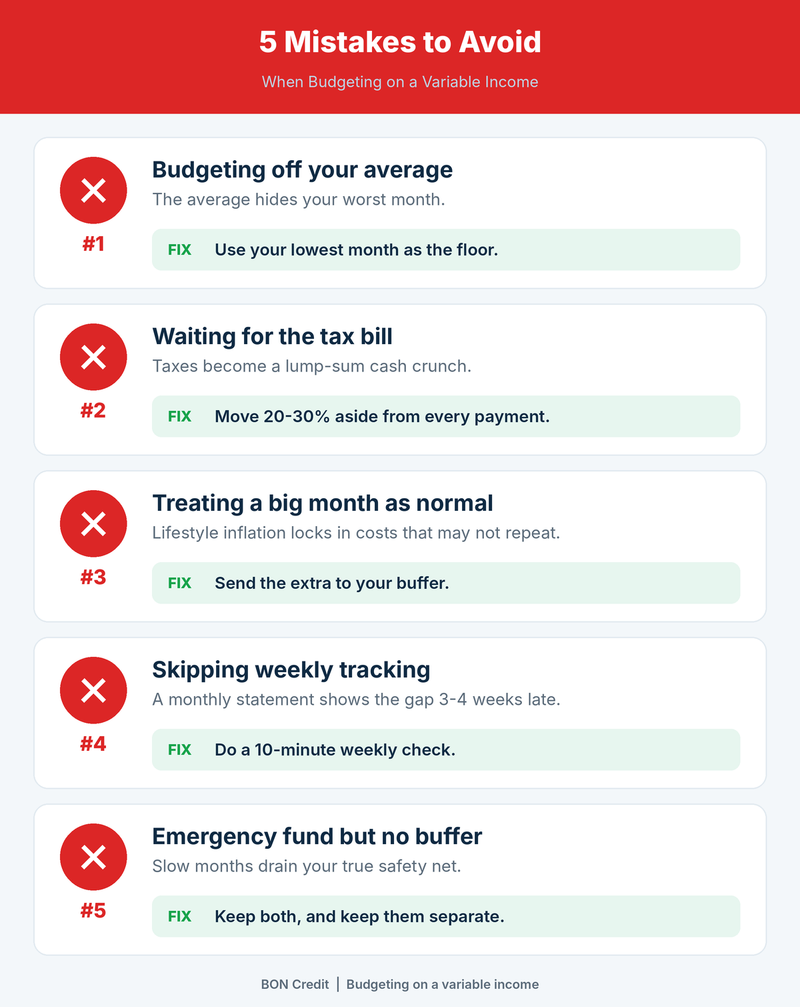
1. Budgeting off your average income. The average smooths over your worst month. If you plan around it, you’re guaranteed to come up short when a true lean month arrives. Use your lowest month instead.
2. Not setting aside taxes until the bill arrives. Without automatic withholding, a tax bill becomes a lump-sum cash crunch on top of whatever income dip you were already facing. Move 20 to 30% aside from every payment.
3. Treating a high-earning month as the new normal. This is lifestyle inflation. A higher rent, a new subscription, or a bigger car payment locks in costs against income that may not repeat. Send the extra to your buffer instead.
4. Skipping weekly tracking until a shortfall has started. By the time a monthly statement shows the gap, you’ve spent 3 to 4 weeks against money that wasn’t there. A ten-minute weekly check fixes this.
5. Building an emergency fund but no smoothing buffer. People drain their true emergency fund on routine lean months. Then nothing is left when a real emergency hits. Keep the two separate, as in strategy three.
How BON Credit Strengthens Budgeting for Variable Expenses
BON Credit is a free AI powered financial assistant that builds a budget for you and tracks every category in real time.
Think about strategy seven. Paying yourself a salary works, but setting it up and maintaining it by hand takes effort. That’s why it quietly lapses after a few months. Automated tracking is what makes it last.
The same goes for strategy four. The weekly review is the step most people drop first. With real-time category tracking in the AI Budget Planner, that review happens continuously, so you don’t have to remember it.
BON Credit also finds money you didn’t know you were losing. It scans your linked accounts for forgotten subscriptions and recurring charges. Redirect what it finds into your smoothing buffer, and the buffer grows without extra effort from you.
Pay and manage all your credit cards, budget, track, and earn, all in one single app.
Download BON Credit for free and start budgeting around your real income.
FAQs
How do I budget when my income changes every month?
Use your lowest-earning month from the past 6 to 12 months as your budget. Pay your essentials from that number. Anything you earn above it goes to a buffer.
What is the 50/30/20 rule for irregular income?
It’s a split of 50% needs, 30% wants, and 20% savings. On irregular income, apply it to your lowest-month floor, not to each month’s actual pay.
How much should I save from each paycheck as a freelancer?
Move 20 to 30% into a separate tax account first. Then save what you can into your buffer. The exact amount depends on your tax bracket and where you live.
Should I use an emergency fund or a buffer in a slow month?
Use the buffer. Keep your emergency fund for real emergencies like medical bills or car repairs. If the buffer is empty, refill it before spending on extras.
What’s the best budgeting app for variable income?
Look for one that tracks spending automatically and shows your categories in real time. BON Credit is free and builds your budget from your linked accounts.
Conclusion
Variable income isn’t the reason budgeting fails. Budgeting off the wrong number is. Build around your floor, not your average, and the rest falls into place.
Remember the Experian numbers: more than 80% of gig workers face unpredictable pay. You’re not alone, and you’re not bad with money. You just need a system built for irregular income.
When you’re ready to stop tracking by hand, try BON Credit

Samder Khangarot
Samder Khangarot is the CEO and co-founder of Bon Credit, a free AI that helps people find money, pay off debt, and build credit. He is a Stanford Graduate School of Business alum.