Why Is Self-Discipline the Key to Becoming a Good Saver?
You mean to save. You even set a goal. Then the month ends and the money is gone.
So, why is self-discipline the key to becoming a good saver? Because saving depends far more on small, repeated daily choices than on income or financial knowledge. Self-discipline is the habit of making the right choice when spending feels easier.
Why is self-discipline the key to becoming a good saver? Because wanting to save is not the problem. Following through is.
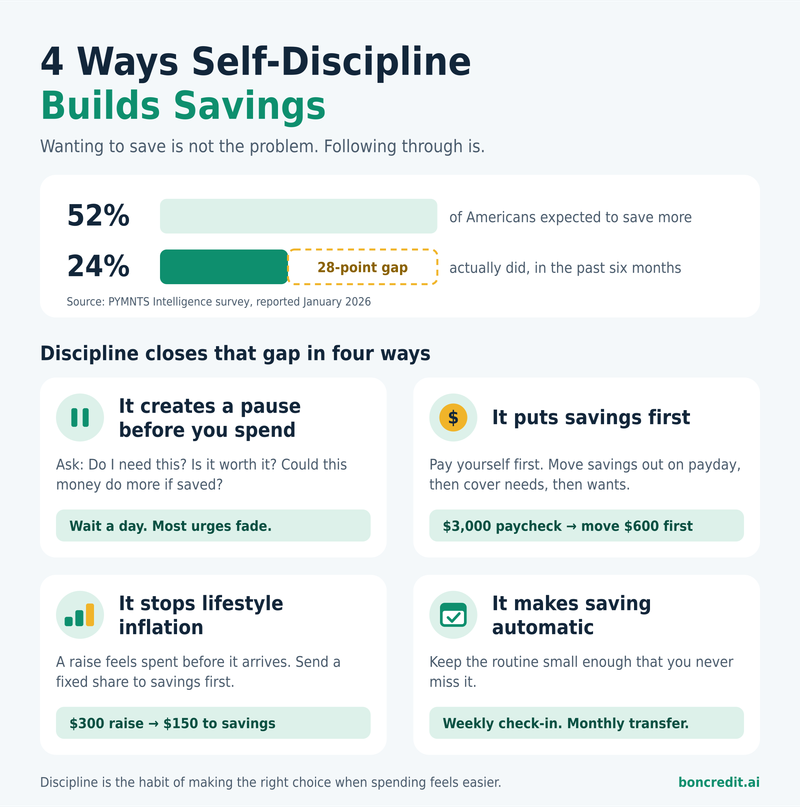
A PYMNTS Intelligence survey, reported in January 2026, found that 52% of Americans expected to save more over the next year. Only 24% had actually increased their savings in the previous six months.
That gap is the heart of this article. Most people already want to save. What they lack is the habit of acting on it, and that habit is what self-discipline gives you.
Key Takeaways
Why is self-discipline the key to becoming a good saver? Saving depends on daily choices, not on how much you earn or how much you know about money.
Self-discipline adds a pause before you spend and keeps savings first in your budget.
Pay yourself first. Move money to savings on payday, before you can spend it.
Raises are the riskiest moment, so watch for lifestyle inflation.
Automatic savings protect your discipline on the days it runs low.
How Self-Discipline Turns You Into a Good Saver
So, why is self-discipline the key to becoming a good saver in daily life? It works in four ways.
It Creates a Pause Before You Spend
Spending is built to be easy. One-tap checkout, buy now pay later plans, and ads that follow you around all remove friction. Self-discipline puts a little back.
This is delayed gratification: waiting a moment so a better choice can show up. Ask three questions before you buy:
Do I need this?
Is it worth it?
Could this money do more if I saved it?
If you can’t say yes to the first two, wait a day. Most urges fade.
It Keeps You Inside Your Budget: Savings First, Not Last
A great principle for saving money is to pay yourself first. Move your savings out on payday, then cover needs, then wants. In short, you should budget in this order, giving savings the first claim on your pay and spending what is left. On a $3,000 paycheck, that means moving $600 before anything else.
The 50/30/20 split is one way to divide the rest. Discipline is what stops the savings transfer from being the first thing you skip.
It Stops Lifestyle Inflation When You Earn More
Lifestyle inflation is when your spending rises every time your income does. A raise or bonus is when discipline matters most, because the extra money feels spent before it arrives.
Try this habit. Before a raise reaches checking, send a fixed share of it to savings. If you get $300 more a month, move $150 over right away.
It Turns Saving Into an Automatic, Repeatable Habit
Saving is not a one-time decision. It is a behavior you repeat, and discipline carries you through the repeats until it feels automatic. Keep the routine small enough that you never miss it.
Three simple routines help:
A 10-minute spending check-in each week
A savings transfer each month
A full review of your goals once a year
How to Strengthen Self-Discipline for Saving
Set a Specific, Written Savings Goal
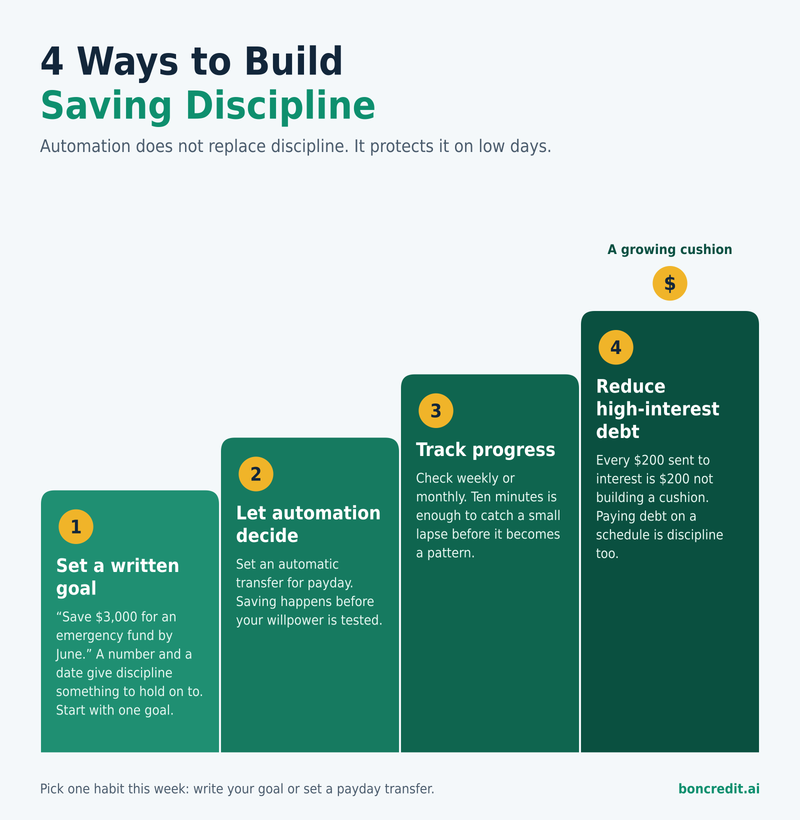
“Save more” is easy to drop. “Save $3,000 for an emergency fund by June” is not. Write it down where you will see it. A number and a date give discipline something to hold on to. Keep it to one goal at first.
Let Automation Take the Decision Away From Willpower
Set an automatic transfer for payday. Then saving happens before your willpower is tested. Automation does not replace discipline. It protects it on the days discipline runs low.
Track Progress Instead of Guessing
Check your savings every week or month. A ten-minute look is enough. A small lapse shows up early, before it turns into a pattern. For the full picture, read why tracking your spending matters.
Reduce Debt So More of Your Income Can Be Saved
High-interest debt competes with savings for the same dollars. Say you owe $2,000 on a card with a high rate. Every month, interest takes a slice of money that could have gone to savings. Every $200 sent to interest is $200 that is not building a cushion.
Paying debt down on a schedule is discipline too. An AI debt payoff planner can show you a faster path.
How Bon Credit Makes Self-Discipline Easier to Keep
Willpower wears down by Thursday. The people who save well do not rely on it. They set things up so saving is the default. Think of it as a guardrail. You still choose the goals, and the guardrail keeps you on the road when motivation dips.
Bon Credit is a free, AI powered financial assistant that automates budgeting and tracks your spending in every category. That is the automation idea from the section above at work: it removes the daily willpower tax, so saving stops being a choice you must win each day.
It also finds forgotten subscriptions and hidden fees. When it surfaces that money, it can send it to savings, so you do not have to notice and act.
Budget, track, manage your cards, and find extra money in one app.
FAQ
How do I become more disciplined with saving?
Start small. Write one goal with a number and a date, then set a payday transfer, even a small one.
How much should I save each month?
Many people aim for 20% of take-home pay. If that is too much now, start at 5% and raise it over time.
Is saving about willpower or income?
Both matter, and rising costs make saving harder. Still, a small amount saved every month beats a large amount saved rarely.
How do I stop overspending?
Pause before purchases and check your spending weekly. Seeing the numbers makes the next purchase easier to question.
So, Why Is Self-Discipline the Key to Becoming a Good Saver? The Gap Tells You
The gap between wanting to save and saving is a discipline gap. It is not an income gap or a knowledge gap. Remember the numbers: 52% expected to save more, and 24% did.
Pick one habit this week. Write your goal or set a payday transfer. If you want help keeping it going, try Bon Credit and let it make saving the default. It takes about ten minutes, and it is the one step most people skip.

Samder Khangarot
Samder Khangarot is the CEO and co-founder of Bon Credit, a free AI that helps people find money, pay off debt, and build credit. He is a Stanford Graduate School of Business alum.