Why Is It Important to Track Your Spending? The Real Benefits Explained

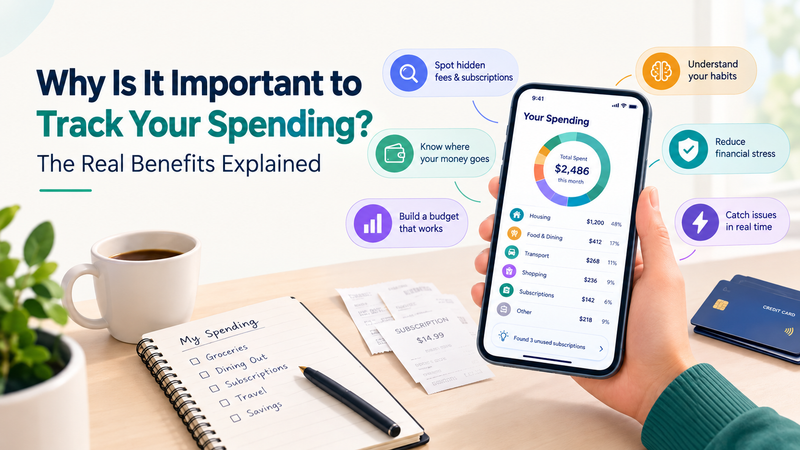
You check your bank balance and it's lower than you expected. Again. Nothing unusual happened this month, no big purchase you can point to. You just have less than you thought, and no clear idea why.
That gap between what you think you spent and what you actually spent is the whole reason tracking matters. Tracking your spending is important because it replaces guesswork with real numbers, and those numbers catch hidden fees, forgotten subscriptions, and spending habits a budget alone will never show you.
Key Takeaway:
Tracking spending means recording every transaction as it happens, which is different from budgeting, which is deciding where money should go.
Most people underestimate subscription costs by over $100 a month and forget they're paying for services they no longer use.
Manual tracking catches what you remember. AI-powered, real-time tracking catches what you don't.
What Does "Tracking Your Spending" Actually Mean?
Tracking and budgeting get used like they're the same thing. They're not.
Tracking is recording what you actually spend, transaction by transaction, as it happens. Budgeting is deciding in advance how your money should be allocated. One is the input. The other is what you do with that input.
You can't build a budget that holds up if you're guessing at the numbers behind it. Tracking comes first. Everything else, including staying budget conscious month to month, is built on top of it.
The Real Benefits of Tracking Your Spending
See Exactly Where Every Dollar Actually Goes
Most people can name their rent, their car payment, their big fixed bills. Few can tell you what they spent on coffee, takeout, or one-tap app purchases last month, and that's usually where the surprise is.
These small, recurring charges don't feel significant one at a time. Totaled over a month, they often outweigh categories people assume are their biggest expense. You only see that total by tracking it.
Turn Guesswork Into a Budget That Actually Holds Up
A budget built on assumed numbers falls apart fast. You guess you spend $400 a month on groceries, set the budget there, and blow past it by week two because the real number was closer to $550.
A budget built on one or two months of actually tracked spending holds up because it reflects reality instead of intention. If you're ready to build yours, the key components of successful budgeting walks through what a durable budget actually needs.
Catch Hidden Fees and Forgotten Subscriptions Before They Add Up
This is where tracking pays for itself. West Monroe research found that 89% of consumers underestimate their subscription spending, and 66% are off by more than $200 a year. C+R Research found people estimate around $86 a month in subscriptions when the real average runs closer to $219.
Worse, 42% of consumers admit they forgot about a subscription entirely while still being charged for it every month. You can't cancel what you don't remember you're paying for. Tracking is the only way to see the real number, not the guessed one.
Understand Your Real Spending Habits, Not Just Your Intentions
You might think of yourself as someone who doesn't spend impulsively. Your transaction history might tell a different story, especially around certain times of day, certain stores, or certain weeks of the month.
Tracking exposes patterns you don't consciously register while they're happening. It's not about labeling those patterns good or bad. It's about seeing them clearly enough to decide if you want to keep them.
Replace Financial Anxiety With a Clear Picture You Can Act On
Not knowing your number is often more stressful than the number itself, even when it's not great news. Uncertainty keeps you checking your balance and hoping. A clear number lets you make a plan.
That shift, from vague worry to a specific figure you can work with, is one of the most underrated benefits of tracking.
Catch Leaks in Real Time, Not a Month Too Late
Most advice on this topic still assumes you'll review your statement once a week or once a month. By then, a duplicate charge or a price increase has already hit you three or four times.
Automated, AI-powered tracking flags unusual or recurring charges as they happen, not at your next scheduled review. That closes the gap between when money leaves your account and when you actually notice.
What Are the Best Ways to Track Your Spending in 2026?
Manual Log or Spreadsheet
A notebook, a notes app, or a simple spreadsheet. Lowest effort to start, full control over categories, but it only works if you keep up with it every single week.
Your Bank or Credit Card App's Built-In Categories
Most banks already sort your transactions automatically, and it's free. The catch is that categories are often generic and don't combine spending across multiple cards or accounts into one view.
A Dedicated Budgeting App
Purpose-built apps sync your accounts and categorize spending for you. This works better than a single bank app if you're managing more than one account or card and want everything in one place.
AI-Powered Real-Time Tracking (2026 Standard)
This is the most complete option available now. It tracks every category as transactions happen and actively looks for money you're missing, not just a record of what you already spent. For most people juggling multiple accounts and subscriptions, this is where tracking stops being a chore and starts finding you money.
How Bon Credit Helps You Track Your Daily and Monthly Spending
Bon Credit is a free AI-powered financial assistant that links to your accounts and tracks every spending category in real time, so you're not manually sorting transactions at the end of each week.
It's built directly for the gaps covered above. Remember that 89% of people underestimate their subscription costs, often by more than $200 a year? Bon Credit surfaces forgotten subscriptions and recurring charges you've stopped noticing, so you see the real total instead of the guessed one. It also flags unusual spending and refunds you may be owed as they happen, not after your next manual check-in.
You link your accounts, Bon Credit tracks and builds a budget around your real spending, and tells you what's worth acting on. Pay and manage your credit cards, track spending, and catch what you're missing, all in one app.
FAQ
Why is it important to track your spending?
Tracking replaces guesswork with real numbers. It shows you exactly where your money goes, catches hidden fees and forgotten subscriptions, and gives you an accurate base to build a budget on instead of an assumed one.
What are two benefits of tracking your spending habits?
It reveals blind-spot categories like subscriptions and small recurring purchases that people consistently underestimate, and it replaces financial anxiety with a clear number you can actually plan around.
What is the best way to track spending?
It depends on how many accounts you manage. A spreadsheet works if you're disciplined and have one account. If you're juggling several cards and subscriptions, AI-powered real-time tracking catches far more than manual review ever will.
Why is tracking your expenses throughout the month important, not just at the end?
Reviewing spending only at month's end means you find problems after they've already repeated three or four times. Tracking throughout the month, or in real time, lets you catch a duplicate charge or overspending pattern while there's still time to fix it.
How does keeping track of your finances help you if you already have a budget?
A budget only works if it's based on real numbers. Tracking is what keeps that budget accurate over time, instead of drifting further from reality every month.
Tracking Is the Foundation Everything Else Is Built On
You can't budget, save, or stay budget conscious with numbers you're guessing at. Tracking is what makes every other money decision accurate instead of hopeful.
Remember the subscription number from earlier: most people are underestimating what they pay by well over $100 a month, and plenty have forgotten a subscription entirely. That alone is reason enough to see your real numbers.
Ready to stop tracking by hand? Get the Bon Credit app and let it track your spending in real time while it looks for money you didn't know you were losing.

Samder Khangarot
Samder Khangarot is the CEO and co-founder of Bon Credit, a free AI that helps people find money, pay off debt, and build credit. He is a Stanford Graduate School of Business alum.