Is the Envelope Budgeting Method Still an Effective Way to Manage Money in 2026?
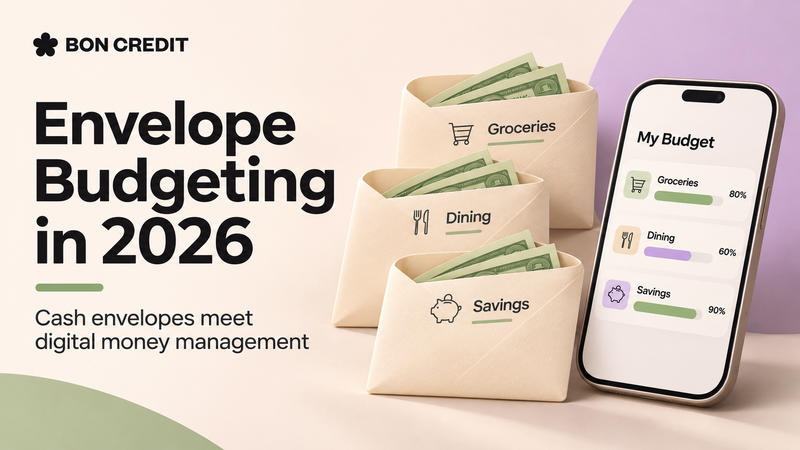
Yes, the envelope budgeting method still works in 2026, but it has split into two versions: physical cash stuffing, revived by TikTok, and digital envelopes built into budgeting apps. It works best for day-to-day variable spending, not fixed bills like rent. The hashtags #cashstuffing, #cashenvelopesystem, and #cashenvelopes have racked up more than 3 billion combined views on TikTok, and Gen Z savers now put away roughly 36% of take-home pay, well above the national average. This guide covers what the method is, how to set it up, where it falls short, and how to run it without the ATM trips.
Key Takeaways
The envelope budgeting method still works in 2026 in two forms: physical cash envelopes and digital envelope apps. Pick the one that matches how you already spend.
The method’s real power is the “hard stop”: once an envelope is empty, overspending in that category becomes physically or digitally impossible.
It’s built for variable spending (groceries, dining out, entertainment), not fixed bills like rent or loan payments.
Cash-stuffing content has over 3 billion combined TikTok views, and Gen Z’s high savings rate is part of why this old method is trending again.
The manual tracking is the method’s weak point in 2026. Automated digital envelopes close that gap without losing the “hard stop” effect.
What Is the Envelope Method of Budgeting?
What is envelope budgeting? The envelope budgeting method is a system where you divide your income into labeled spending categories, or “envelopes,” and stop spending in a category once that envelope runs dry. Each envelope holds a fixed amount for the pay period, nothing more.
Two formats exist side by side today. Physical cash envelope system budgeting means withdrawing cash and sorting it into real envelopes by hand. Digital envelopes do the same job inside a budgeting app or a bank’s sub-accounts, no cash involved.
This isn’t a new idea; households have used paper envelopes for generations. What’s new is the comeback.
How Does Envelope Budgeting Work?
How does envelope budgeting work? You size your spending money, split it into a short list of categories, fund each one, then spend only from the matching envelope until the next payday. Five steps cover the whole process.
Step 1: Total Your Take-Home Income
Start with your net monthly pay, after tax. Some people use the 50/30/20 split (needs, wants, savings) as a rough starting point before dividing further. Treat it as a reference, not a rule.
Step 2: Build Your Category List
Separate fixed bills (rent, car payments, insurance) from variable spending (groceries, dining out, gas, entertainment). Only the variable categories get envelopes. Five to eight envelopes is typical. Fewer loses precision; more turns into admin work that defeats the point.
Step 3: Fund Each Envelope
Put a set dollar amount into each envelope at the start of the pay period. Base the number on one or two months of actual past spending in that category, not a guess. Guessing is how a cash envelope system budget fails by week one.
Step 4: Spend Only From the Matching Envelope
Every purchase draws down the envelope for that category, never another one. Once it’s empty, spending there stops for the period. The one accepted exception: knowingly pulling from a lower-priority envelope to cover a higher one, as a deliberate trade-off, not quiet overspending.
Step 5: Refill and Review at the Next Pay Period
Envelopes reset on a schedule, weekly, biweekly, or monthly, matching how you get paid. Each reset is also a checkpoint to fund a category higher or lower based on how the last period actually went.
Quick Reference: Physical Cash Envelopes vs. Digital Envelopes
What Is One Benefit of Envelope Budgeting?
What is one benefit of envelope budgeting? The hard stop. Once a category’s envelope is empty, overspending there becomes physically or digitally impossible, which a credit card with no visible limit simply can’t match.
This isn’t a fringe habit anymore. Cash-stuffing content has pulled in over 3 billion combined TikTok views across #cashstuffing and related hashtags, making it one of the more visible budgeting trends of 2026, especially among younger savers.
Two smaller benefits stack on top. Watching a balance deplete gives feedback a bank statement doesn’t. And the friction of handing over cash, or pausing to check a shrinking app balance, slows down impulse buys before they happen. Behavioral economists call this the “pain of paying”: parting with cash registers more strongly than a card swipe, which is a large part of why budgeting with cash envelopes outperforms willpower alone.
What Kind of Expenses Is the Envelope System Especially Helpful For?
The envelope system is especially helpful for expenses like groceries, dining out, entertainment, gas, and personal shopping, the categories that swing the most from month to month.
Groceries – changes week to week, so a fixed envelope keeps it in check.
Dining out and takeout – the highest-risk category for impulse spending.
Entertainment – easy to lose track of across several small charges.
Gas – fluctuates with how much you actually drive.
Personal shopping and hobbies – the most discretionary, and the most prone to overspend.
It’s not built for fixed bills like rent, a mortgage, or loan payments. That’s not a flaw, it’s precision: those amounts don’t change, so they don’t need a category you can overspend.
One nuance: irregular costs like gifts or annual subscriptions can get their own envelope too, funded gradually over several pay periods instead of all at once, the way a sinking fund works.
Because the method is built for variable spending, how well it still works in 2026 depends partly on which format you pick, cash or digital.
Is the Envelope Method Still Helpful in 2026?
Yes, but the format has shifted. It’s no longer a strictly paper-and-cash system. It now runs as cash stuffing on one side and digital envelopes, inside apps or bank sub-accounts, on the other.
Gen Z’s savings habits explain part of the resurgence. Gen Z savers set aside roughly 36% of take-home pay, compared with around 27% for the average consumer, according to PYMNTS Intelligence research. That lines up with the same TikTok cash-stuffing wave driving the hashtag numbers above.
Why it still works comes down to three things: the pause before a purchase, the feedback as a balance drops, and the hard stop that keeps spending from rolling onto a credit card.
Where it falls short, honestly: it doesn’t fit fixed bills, and it doesn’t, on its own, solve longer-term saving, investing, or paying down debt. For fixed expenses vs. variable expenses, the envelope method only ever covers half the picture.
The behavior still holds up in 2026. The manual tracking doesn’t. Counting cash by hand, or checking five app categories, is where most people quietly give up, and that’s where automation earns its place.
How Bon Credit Modernizes the Envelope Method
Bon Credit is a free AI-powered budgeting app that builds your budget automatically and tracks every category in real time, a digital version of the envelope budgeting method without the ATM trips, the cash-loss risk, or the manual refilling every payday.
The same mechanics that make envelope budgeting work still apply inside Bon Credit: a visible limit per category, feedback as a balance moves, and a hard stop before you overspend. It just updates itself, which also helps with curbing impulse spending in the categories envelopes were always meant to protect.
Bon Credit’s “found money” feature adds something cash envelopes can’t: it scans linked accounts for forgotten subscriptions and refunds, then redirects that money straight into a category instead of needing a separate envelope for it. Pay and manage your credit cards, budget, track spending, and find extra money, all in one app.
See how Bon Credit’s AI powered financial assistant works and link your accounts to get a budget built for you in minutes.
Bottom Line
The envelope budgeting method still works in 2026, for variable spending specifically, in whichever format fits how you actually spend: cash in hand or an app on your phone. This isn’t a dated method. Over 3 billion TikTok views and Gen Z’s above-average savings rate say the opposite.
If the cash version sounds like more admin than you want, an AI agent that tracks your spending for you is the low-effort way to get the same hard stop, automatically.
FAQs
What is the envelope method of budgeting?
It’s a system where income is split into labeled categories, cash or digital, and spending in each one stops once that category’s money runs out. It’s one of the oldest budgeting methods, now making a visible comeback.
What is one benefit of envelope budgeting?
The built-in hard stop. Once an envelope is empty, you physically or digitally can’t overspend in that category, unlike a credit card with no visible limit telling you to slow down before the bill arrives.
Is cash stuffing the same as envelope budgeting?
Cash stuffing is the physical version of envelope budgeting, using real cash sorted into paper envelopes by category. Digital envelopes, built into apps or bank sub-accounts, do the exact same job without handling physical cash at all.
Can envelope budgeting work for irregular expenses like gifts?
Yes. Fund a dedicated envelope gradually over several pay periods instead of all at once, similar to a sinking fund, so a once-a-year cost like holiday gifts doesn’t blow up a single month’s budget.
Does envelope budgeting work with bills like rent or a mortgage?
Not directly, and that’s by design. Fixed bills don’t fluctuate month to month, so they don’t need a spending limit. Envelope budgeting is built for variable categories like groceries and dining out, not fixed monthly payments.

Samder Khangarot
Samder Khangarot is the CEO and co-founder of Bon Credit, a free AI that helps people find money, pay off debt, and build credit. He is a Stanford Graduate School of Business alum.