Why Is Goal Setting Important in the Financial Planning Process?

Goal setting matters in financial planning because it turns vague intentions into a specific, measurable target. That target shapes every saving, spending, and investing decision you make along the way. Without it, money tends to go wherever the month takes it.
Key Takeaways
Why is goal setting important in the financial planning process? It gives every dollar a direction and a deadline.
A financial goal is a specific, measurable money target tied to a timeframe.
Most people set goals. Few finish them, and the gap is usually process, not effort.
Rank your goals, make them SMART, check progress on a schedule, and adjust as life changes.
Starting early and automating your savings make the biggest difference.
Financial Goals Definition: What Is It Exactly?
A financial goal is a specific, measurable money target with a timeframe. “Save more” is a wish. “Save $1,000 in six months” is a goal.
Goals come in different sizes:
Build a $1,000 starter emergency fund.
Pay off a credit card.
Save a home down payment.
Each one has a number and an end point. That’s what makes it a goal. If you want the wider picture, read about the types of financial planning.
Why Goal-Based Financial Planning Matters for Your Future?
Because most people who set goals don’t reach them. An Insurify survey from January 2026 found that 89% of Americans did not accomplish all of their 2025 financial goals. Only 11% did.
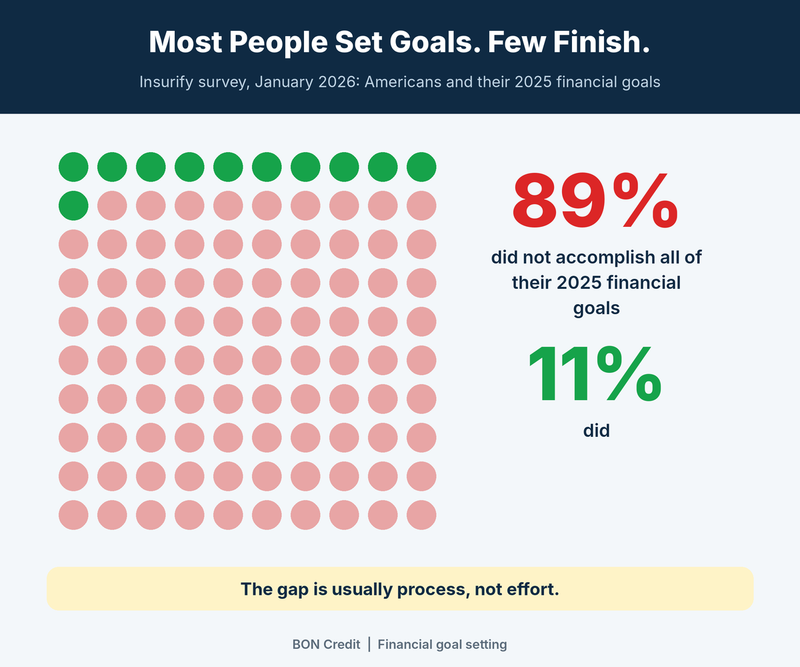
Effort isn’t usually the problem. The process is. Goal-based financial planning fixes that in four ways:
It gives decisions direction. You know why you’re saving or skipping a purchase.
It helps you prioritize. Competing goals get an order instead of a reaction to cash flow.
It matches investments to timelines. Money you need in two years shouldn’t carry the same risk as retirement money.
It creates accountability. A budget tracks spending. A goal tells you what the spending is for.
Goal setting is one of the key components of financial planning. The steps below show how to do it well.
How to Set Financial Goals and Achieve Them?
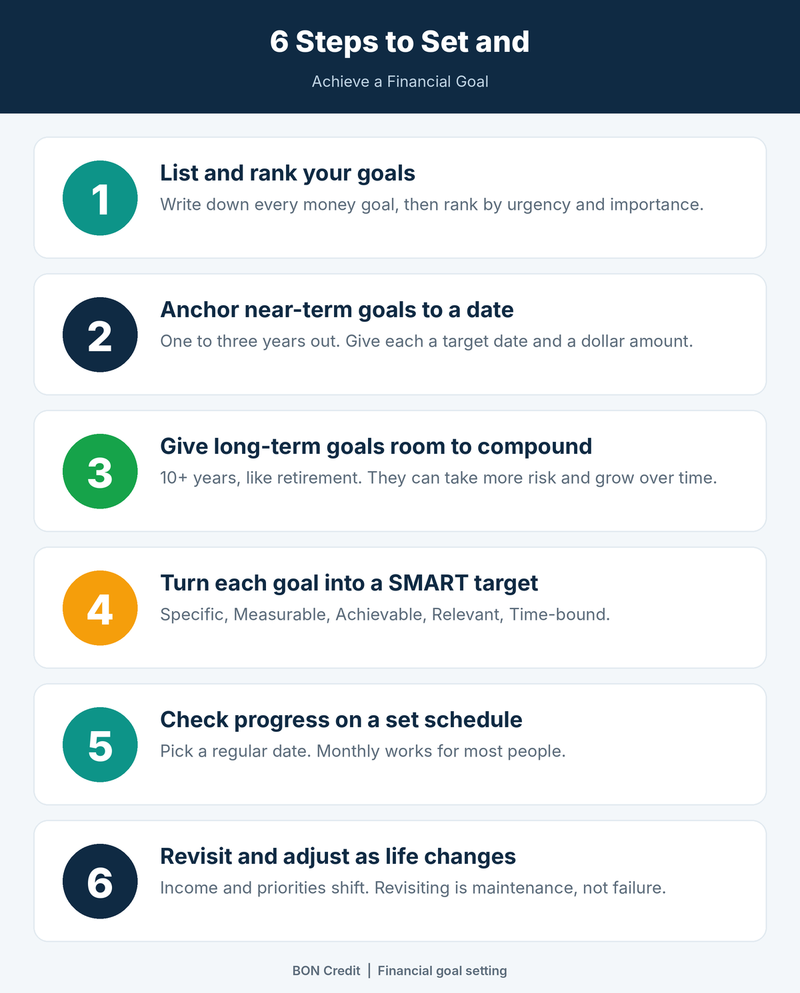
Follow six steps. Write each goal down, give it a number and a date, and check it on a schedule.
1. List and Rank Your Financial Goals
Write down every money goal on your mind. Then rank them by urgency and importance.
Prioritizing financial goals matters because your income is limited. Competing goals need an order, not an “all at once” approach.
2. Anchor Near-Term Goals to a Specific Date
A near-term goal runs roughly one to three years. It needs a target date and a dollar amount, not a loose intention.
For ideas, see these examples of short-term financial goals.
3. Give Long-Term Goals Room to Compound
Long-term goals, like retirement, run 10 years or more. They can handle more investment risk and benefit from compounding.
That’s the key contrast with step two. Near-term money stays safe. Long-term money has time to grow.
4. Turn Each Goal Into a SMART Target
SMART stands for Specific, Measurable, Achievable, Relevant, and Time-bound.
Here’s an example. “Save more” becomes “Save $3,000 for an emergency fund by December 2026.” Now you know the amount, the purpose, and the deadline.
5. Check Progress on a Set Schedule, Not Randomly
A goal without a check-in schedule tends to drift. Nothing in your week catches the slip.
Pick a regular date, monthly works for most people, and look at where you stand. It’s the same habit as why tracking your spending matters, applied to your goal instead of your purchases.
6. Revisit and Adjust as Life Changes
Income changes. Priorities shift. A goal you set a year ago may no longer fit.
Revisiting isn’t failure. It’s maintenance.
What Will Make the Biggest Impact on Your Financial Future?
Two things matter most: starting early and automating the gap between your income and your goal.
Starting early gives compounding time to work. A small amount invested years ahead can outgrow a larger amount invested late.
Automation removes willpower from the equation. Move money toward your goal the day income arrives, before you can spend it. This is what closes the gap behind that 89% number. Most people don’t lack goals. They lack a system that runs without them.
Budgeting is the day-to-day engine behind both. Here’s how a budget helps you reach financial goals.
How BON Credit Keeps Your Financial Goals on Track
BON Credit is a free AI powered financial assistant that tracks every category in real time and builds your budget automatically.
That ties straight to step five. Instead of relying on yourself to remember a monthly check-in, automated tracking does it for you. You can see how you’re doing at any moment.
BON Credit also surfaces forgotten subscriptions and refunds. Redirect that found money toward a specific goal, so it doesn’t disappear into everyday spending.
Pay and manage all your credit cards, budget, track, and earn, all in one app.
Download BON Credit for free and put your goals on autopilot.
FAQs
What are the 4 main financial goals?
Most people aim for an emergency fund, debt payoff, a major purchase like a home, and retirement savings.
How do I set a financial goal if I’m starting from zero?
Start small. Pick one goal, like $500 saved, and give it a date. Add more goals once the first one feels doable.
How often should I review my financial goals?
Monthly works for most people. Check your progress, then adjust if your income or life has changed.
What’s the difference between a short-term and a long-term financial goal?
Short-term goals take one to three years, like an emergency fund. Long-term goals take 10 years or more, like retirement.
Bottom Line
Goal setting isn’t the hard part. Most people already know what they want. The structure is what closes the gap: SMART targets, scheduled check-ins, and regular adjustments.
The stakes are real. Only 11% of Americans hit all their 2025 goals.
If you’d like the tracking piece handled for you, try BON Credit.

Samder Khangarot
Samder Khangarot is the CEO and co-founder of Bon Credit, a free AI that helps people find money, pay off debt, and build credit. He is a Stanford Graduate School of Business alum.