Static Budget vs. Flexible Budget: Which Is Right for You?
Objective
Help readers understand the practical difference between a static budget and a flexible budget, decide which one fits their income and personality, and show how real-time tracking through Bon Credit makes either method actually work.
Key Takeaways
A static budget locks in a dollar amount per category. A flexible budget lets those amounts move with your actual income.
Neither one is "better." The right choice depends on how predictable your paycheck is and how much upkeep you want to do.
Most people aren't locked into one method for life. Switching temporarily during a job change, a slow season, or a financial reset is normal.
Whatever structure you use, it only works if you can see your spending as it happens.
You made a budget in January. By March, it doesn't match your life anymore.
Maybe your hours changed. Maybe rent went up. Maybe you picked up freelance work on the side and now half your income shows up in irregular chunks. The budget you built still assumes the same $500 for groceries every single month, whether that's realistic or not.
This is the exact fork in the road between a static budget and a flexible budget. One keeps the same numbers no matter what happens. The other moves with you. Picking the wrong one isn't a moral failing, it's just a mismatch between your income and your method.
TL;DR: A static budget assigns a fixed amount to each category that never changes month to month. A flexible budget adjusts those amounts based on your actual income or expenses. The right pick comes down to how predictable your money is, not which method is objectively smarter. Many people use static most of the year and switch to flexible during a specific stretch of change.
A static budget also isn't the same thing as only having fixed expenses. You can assign a fixed dollar amount to a category that's naturally variable, like groceries, and it's still static. If that distinction is fuzzy, our guide on fixed vs. variable expenses breaks it down further.
What Is a Static Budget?
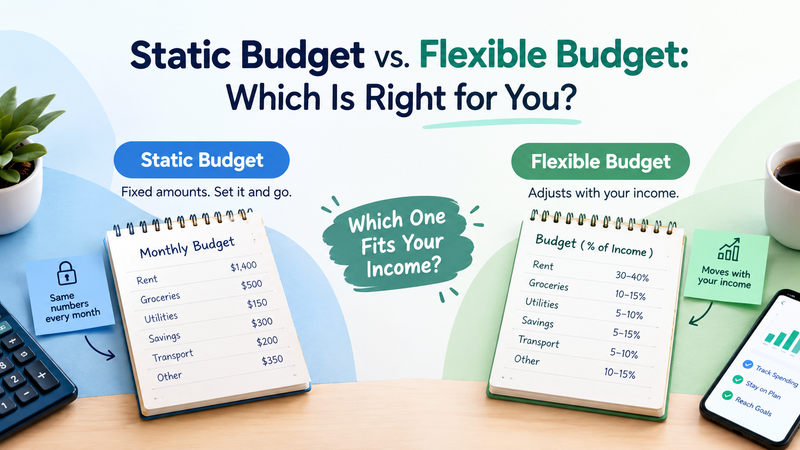
A static budget assigns a fixed dollar amount to each category at the start of the month, and it doesn't move regardless of what actually happens. $500 for groceries stays $500 whether you spend more or less.
The appeal isn't just "steady income." It removes a decision. Nobody has to sit down every month and re-plan. The numbers are already set, which is exactly why this is the lower-effort option of the two.
It fits salaried employees, people with a consistent rent or mortgage, and anyone who does better with firm limits than with numbers that shift around. If you know what's coming in and what's going out, static budgeting keeps things simple.
The trade-off shows up the moment something genuinely changes. That same rigidity that makes static budgets easy to follow is also the biggest weakness when life doesn't cooperate.
Example of a Static Budget
Say you bring home $4,000 a month. A static budget might look like this: $1,400 for rent, $500 for groceries, $150 for utilities, $300 into savings, with the rest split across transportation, insurance, and discretionary spending. Those numbers stay the same in July as they do in December, whether your actual grocery bill runs high or low that month.
What Is a Flexible Budget?
A flexible budget scales category amounts up or down based on actual income or circumstances that month. A stronger month means more gets allocated. A leaner one means categories shrink to match.
Rather than fixed dollar figures, flexible budgeting often sets categories as a percentage of that period's income. The math redoes itself automatically as income changes, so you're not manually rebuilding the budget every time your paycheck looks different.
This fits freelancers, gig workers, commission-based earners, tipped employees, and seasonal workers, basically anyone whose income genuinely varies rather than just feels unpredictable. Standard monthly budget tracking becomes more important here, since the numbers you're working from change constantly.
The same adaptability that makes this realistic is also what makes it easy to overspend the second a good month shows up, without a firm number holding the line.
Example of a Flexible Budget
A freelancer earns $3,200 one month and $4,100 the next. Under a flexible budget, savings and discretionary spending scale up in the stronger month instead of staying frozen at the same dollar amount both times. If savings are set at 10% of income, that's $320 one month and $410 the next, automatically. For a full walkthrough on setting this up, see our guide on budgeting on a variable income.
Static Budget vs. Flexible Budget: 8 Key Differences
Most comparisons stop at "fixed vs. scales." These eight go deeper, and several are specific to personal finance rather than the business-focused version of this topic.
Three of these rows deserve more than a table cell.
Psychological experience. This is the row most comparisons skip, and it's often the real reason a method sticks or gets abandoned. A static budget's rigidity is a feature if you want a bright line. A flexible budget's forgiveness is a feature if you'd otherwise quit after one bad month. Neither is a personality flaw. Matching the method to how you actually think about money matters as much as matching it to your income.
How savings behaves. A fixed $300 savings target under a static budget is either too aggressive in a lean month or leaves money on the table in a strong one. A percentage-based rate under a flexible budget scales automatically, which sounds strictly better until income drops enough that even a percentage of it stops being meaningful. That's where combining in a static floor, a minimum dollar amount regardless of percentage, is worth doing.
Works best with. A static budget can survive on a once-a-month glance since the numbers don't move. A flexible budget without frequent tracking isn't really flexible, it's just guessing with extra steps, because nobody's actually recalculating in practice. This is where real-time tracking stops being a nice-to-have.
One quick clarification: "static budget variance" is a formal accounting term for actual results minus the static budget amount, used in business analysis. For a personal budget, the same idea in plain terms is just the gap between what you planned and what actually happened.
Advantages and Disadvantages of Both
Static Budget
Flexible Budget Advantages and Disadvantages
When Would I Use Flexible vs. Static Budgeting?
Most advice stops at "static for steady income, flexible for variable income." True, but incomplete.
Most people don't have to pick one permanently. It's reasonable to run a static budget most months and switch to flexible during a specific window: starting a new job while income is still settling, recovering from a financial emergency, a seasonal dip if your work is cyclical, or the first few months of freelancing before your patterns become predictable.
Ask yourself three questions:
Has my income changed in two of the last three months?
Do I know what I'm earning next month within about 10%?
Would a fixed number feel like a helpful limit right now, or an unrealistic one?
Two or more answers pointing toward unpredictability means flexible fits better. The reverse points toward static.
Once income and expenses stay predictable for two to three consecutive months, a static budget becomes workable again. Flexible budgeting is a mode you move in and out of, not a permanent identity. If you're weighing other structures too, our comparison of incremental vs. zero-based budgeting covers a different angle on the same decision.
Track Your Budget and Save Money in Real Time With Bon Credit
Here's something a 2026 West Monroe survey found: 89% of people underestimate their own spending. That number matters regardless of which budget structure you use, because neither static nor flexible budgeting works without accurate, current numbers.
Whether a budget is static or flexible matters less than whether you can actually see what's happening as it happens. A fixed budget you never check carries the same risk as a flexible one you never update.
Bon Credit tracks every category in real time underneath either structure. It flags when a static category is about to be exceeded, and it recalculates what's available in a flexible one as your actual income comes in. Because the app already shows your income and spending patterns over time, it can answer questions 1 and 2 from the self-check above automatically, no digging through old statements required.
And when Bon Credit's AI powered financial assistant finds money elsewhere, a forgotten subscription, a refund you're owed, that money can go straight toward a static category that's running short or a flexible category that just scaled up.
Static Budget vs. Flexible Budget: The Bottom Line
Static and flexible budgets solve the same problem in different ways. The right one depends on how predictable your income is, and it's fine to move between them as your circumstances change instead of picking one forever.
What actually determines whether either method works is real-time visibility into your money, more than the structure itself. That's the part Bon Credit was built to handle. Get the app and see how your budget looks with the guesswork removed.
FAQ
Is a static budget the same as only having fixed expenses?
No. A static budget can assign a fixed dollar amount to a variable category like groceries or gas. It's static because the number doesn't change, not because the expense itself is naturally fixed.
Can I use a static budget with irregular income?
You can, but it's harder to stick to. If your income swings by more than 10 to 15% month to month, a flexible budget or a hybrid approach usually holds up better.
How often should I switch between static and flexible budgeting?
There's no set schedule. Switch when your income situation actually changes, a new job, a layoff, a seasonal slowdown, and switch back once things settle for a couple of months.
What's the biggest mistake people make with flexible budgeting?
Treating a good month as extra spending money instead of extra savings. Without a floor on savings, a flexible budget can quietly become no budget at all.
Do I need an app to run a flexible budget?
Not strictly, but it helps a lot. Recalculating percentages by hand every time income changes gets old fast, which is where most people give up on the method.

Samder Khangarot
Samder Khangarot is the CEO and co-founder of Bon Credit, a free AI that helps people find money, pay off debt, and build credit. He is a Stanford Graduate School of Business alum.