Incremental vs. Zero-Based Budgeting: Which One Fits Your Income?
Key Takeaways
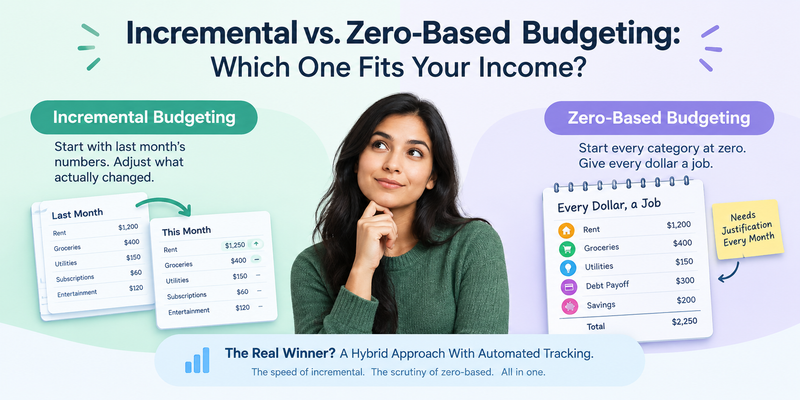
The difference between incremental and zero-based budgeting comes down to starting point: incremental adjusts last month's numbers, zero-based starts every category at zero and rebuilds it.
Incremental vs. zero-based budgeting isn't about which is "correct." It's about matching the method to how predictable your income and spending are.
Zero-based vs. incremental budgeting trades speed for scrutiny. ZBB catches waste faster; incremental saves time each month.
Budgeting for stable vs. irregular income usually decides the winner before pros and cons even matter.
A hybrid budgeting approach, where software tracks spending automatically, gives you both speed and accuracy without picking a side.
Your paycheck hits, rent comes out, and you copy last month's numbers into a new sheet with a few tweaks. That's budgeting for most people. It works, until a subscription you forgot about quietly eats $40 a month for a year straight. That's the trade-off at the center of incremental vs. zero-based budgeting, and picking the wrong one for your situation costs real money.
This isn't a debate you need an accounting degree to settle. Once you see how each method actually behaves month to month, the right fit becomes obvious.
What Is Incremental Budgeting?
Incremental budgeting starts with last period's actual numbers and adjusts them for what's genuinely changing. Rent went up $50, so you add $50. Everything else carries forward untouched.
What Actually Happens Each Month With Incremental Budgeting?
You look at what's different this month, update only those categories, and leave the rest alone. No rebuilding, no full review. For a deeper breakdown with worked examples, check out incremental budgeting, explained in full.
What Is Zero-Based Budgeting?
Zero-based budgeting starts every category at zero. Every dollar of income gets assigned a job, spending, saving, or debt payoff, until income minus allocations equals zero.
What Actually Happens Each Cycle With Zero-Based Budgeting?
You rebuild the plan fresh each period around actual expected expenses. Nothing carries over automatically, and every category has to justify itself again. For the full step-by-step process, see zero-based budgeting, explained in full.
The Difference Between Incremental and Zero-Based Budgeting
What are the key differences between incremental and zero-based budgeting? It comes down to five factors: starting point, effort, speed, risk, and best fit.
This is really the budget baseline vs. budget justification question in disguise. Incremental trusts the baseline. Zero-based demands justification every time.
Which Budgeting Method Actually Fits Your Situation?
When Zero-Based Budgeting Is the Right Approach
ZBB fits three situations: a major income change like a new job or job loss, an active push to pay down debt fast, or recovering from a financial emergency. Forcing every dollar to justify itself is exactly what catches the specific habits worth cutting when you need a fast reset.
It also works well when building an emergency fund from scratch, since every category gets scrutinized until the savings goal fits.
When Incremental Budgeting Is the Right Approach
Incremental fits a steady paycheck, consistent month-to-month expenses, or a budget that already works and just needs fine-tuning. It's faster specifically because it trusts last period's numbers, which is exactly why it still needs a periodic full check to catch anything drifting unnoticed. If your income isn't steady, budgeting on an irregular income usually calls for more structure than incremental alone provides.
So, which budgeting method is better? Neither, universally. Pros and cons of incremental and zero-based budgeting only make sense once you know whether your income and expenses are predictable.
How to Get the Best of Both With Bon Credit
Here's where a personal budget differs from a business one. A company has to commit to one method for its accounting cycle. You don't.
A recent West Monroe survey found that 89% of people underestimate their own spending, which is exactly the gap incremental budgeting's speed can leave open. That's the risk of trusting last month's numbers without checking them.
Bon Credit closes that gap. It auto-tracks every category in real time, functioning like an ongoing zero-based review running quietly in the background, flagging a category that's grown or a charge that no longer makes sense, without the manual rebuild ZBB normally requires.
Because the budget updates automatically from actual spending, it behaves like an incremental budget day to day (fast, low-effort) while still catching waste the way a zero-based approach does. That's a real hybrid budgeting approach, without extra work on your end.
Bon Credit's core budgeting is free, with real-time category tracking, AI-surfaced missed money, support for either method, and read-only bank connections that never move your money.
If you're thinking about switching from incremental to zero-based budgeting just to catch more waste, this is worth trying first.
Conclusion
Neither method wins outright. Incremental fits stability. Zero-based fits change or recovery. The deciding factor is your own income and how much effort you want to put in each month, not a rule someone else made up.
Automated tracking is what lets a personal budget get both methods' benefits at once, something a business simply can't do. Bon Credit builds that into the background of your budget, so you get speed without losing the scrutiny that catches waste.
FAQ
Do I have to pick one budgeting method and stick with it forever?
No. Most people's needs change with their income. Switch methods when your situation shifts, or use software that handles both at once.
Is zero-based budgeting too much work for someone with a simple, steady paycheck?
For most steady-income households, yes, it's overkill month to month. A periodic ZBB check every few months, paired with incremental budgeting in between, covers most people well.
Can incremental budgeting hide overspending?
Yes, if categories never get reviewed. Small increases add up quietly over a year. That's why an occasional full review matters, even with incremental budgeting.
What's a good sign it's time to switch from incremental to zero-based budgeting?
A big income change, mounting debt, or a budget that no longer matches reality are the clearest signals.
Does automated tracking replace budgeting altogether?
No. It removes the manual math, not the decisions. You still choose your goals; the tracking just keeps your numbers honest.

Samder Khangarot
Samder Khangarot is the CEO and co-founder of Bon Credit, a free AI that helps people find money, pay off debt, and build credit. He is a Stanford Graduate School of Business alum.