How Budgeting and Saving Money Can Help Achieve Your 2026 Financial Goals?
A budget helps you reach your financial goals by giving every dollar a specific job. It shows you where money is slipping away and sets aside savings and debt payments before anything else gets spent. That’s how a goal you want becomes a goal you’re actually paying for each month.
Most people don’t struggle with setting goals. They struggle with funding them. According to a Vanguard survey, nearly three in four Americans missed their saving and spending goals in 2025. So, how can a budget help you reach your financial goals when intention alone keeps falling short?
This blog walks through what a budget can do for you, seven ways it moves you toward your goals, and how to pick the method that fits your life.
Key Takeaways
A budget is a plan for spending and saving money. It decides where each dollar goes before the month starts.
How can a budget help you reach your financial goals? It funds your goals first, exposes spending leaks, and protects your progress from surprise bills.
Goal based budgeting works because savings stop being “whatever’s left over.”
The best time to set a savings goal is right before a big purchase, right after a raise, or at the start of a new month.
No single budgeting method fits everyone. Pick one based on your goal and how steady your income is.
Automation beats willpower. Moving goal money on payday keeps it from getting spent.
What Can a Budget Help You Do?
A budget helps you do three things: see where your money goes, protect yourself from money shocks, and make steady progress on what you care about. Think of it as a plan for spending and saving money that you set before the month starts, not something you look back on afterward.
Track: See Exactly Where Your Money Goes
Most people underestimate their spending. A $15 streaming plan you forgot about, a daily coffee run, or a gym you stopped visiting can add up to hundreds a month. Tracking puts those leaks on the table so you can decide what stays.
Protect: Keep a Surprise Bill From Becoming Debt
A budget separates needs from wants. It also sets money aside for an emergency cushion. When the car needs a $700 repair, you pay it from savings instead of putting it on a credit card. That keeps you from overspending and leaning on high-interest debt.
Progress: Fund Your Goals on Purpose
This is the part most people skip. What can a budget help you do beyond tracking? It sends a set amount toward a named goal every month, whether that’s a down payment, school fees or retirement. Your goals get paid first, not last.
How Budgeting Helps You Reach Your Financial Goals: 7 Key Ways
How can budgets help you achieve your financial goals? Mostly by putting structure where good intentions usually fall apart. Here are the seven ways that show up most often.
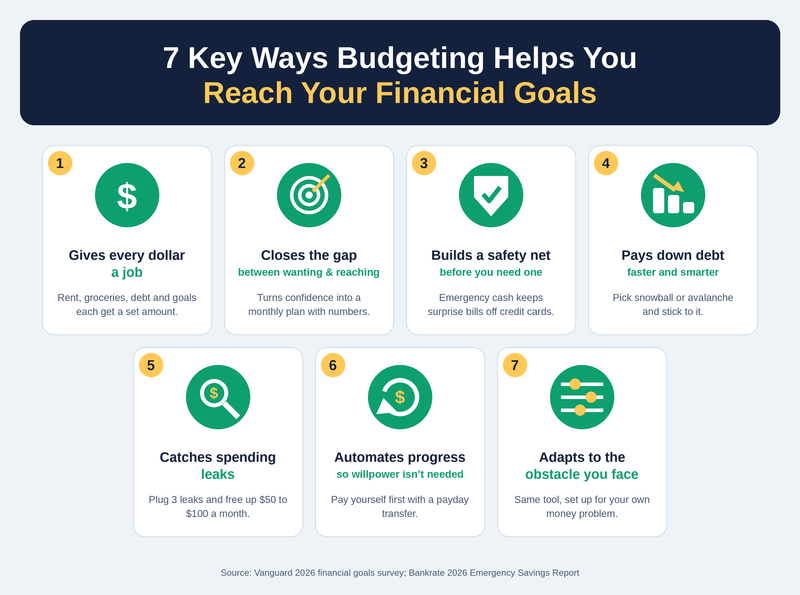
1. It Gives Every Dollar a Job
Goal based budgeting means every dollar you earn gets assigned a purpose before you spend it. Rent, groceries, debt and your vacation fund each get a set amount. When money has a job, it’s much harder to spend on whatever comes along.
2. It Closes the Gap Between Wanting a Goal and Reaching It
Most people already have the motivation. In the same Vanguard survey, 84% of Americans said they had set a financial resolution for 2026, and 82% felt confident they’d reach it.
Yet most missed their goals the year before. Confidence clearly isn’t the problem. A budget gives that confidence a monthly plan with real numbers behind it.
3. It Builds a Safety Net Before You Need One
A good budget sets aside emergency money before the emergency. Without that cushion, one dental bill can wipe out three months of goal savings. With it, your goal fund stays untouched.
4. It Helps You Pay Down Debt Faster and Smarter
Debt and savings often compete for the same dollars. In Bankrate’s 2026 Emergency Savings Report, 31% of Americans said paying down credit card debt and building emergency savings are equally important to them.
A budget lets you do both on purpose. Once your monthly numbers are clear, you can pick a payoff strategy:
Debt snowball: pay the smallest balance first for quick wins and momentum.
Debt avalanche: pay the highest interest rate first to save the most money.
Either one works better than spreading random payments across every card.
5. It Catches Spending Leaks Draining Your Goal Fund
Small charges that repeat every month do the most damage because they’re easy to forget. Common leaks include:
Subscriptions you no longer use
Duplicate or hidden bank fees
Daily habits like delivery orders or coffee runs
Free trials that quietly switched to paid plans
Plug three of those and you might free up $50 to $100 a month for your goal.
6. It Automates Progress So You Don’t Rely on Willpower
“Pay yourself first” is one of the most reliable budgeting and saving techniques for long-term financial goals. You set an automatic transfer to your goal account on payday, before you can spend that money. You can’t spend what you never see in your checking account.
7. It Adapts to the Obstacle You Actually Face
Different people get stuck in different places. Vanguard found that Baby Boomers worry most about unexpected expenses (29%), Millennials struggle with not earning enough (22%), and Gen Z is the most likely to live beyond their means (15%).
A budget can bend to fit each problem:
This is why budgeting to help reach your financial goals looks different for everyone. The tool stays the same. How you set it up depends on the obstacle in your way.
When Can Setting a Savings Goal Help You?
A savings goal helps most at moments when your money is about to change direction. If you set a target at those points, the extra money goes toward your goal before your spending quietly grows to absorb it.
So when can setting a savings goal help you? These four moments matter most:
Before a big purchase. Saving for a car or a laptop ahead of time means you don’t have to finance it.
Right after a raise or new job. Commit the extra income to a goal before “lifestyle creep” eats it up.
At the start of a new budget period. A fresh month or a new year is a natural reset point.
Right after missing a goal. Like the three in four Americans who fell short in 2025, you can restart with a smaller, specific target.
To go deeper on the “why” behind goals, read our guide on why is goal setting important in the financial planning process.
Which Budgeting Method Fits Your Financial Goals?
The right method depends on your goal and how predictable your income is. There isn’t one method that works best for everyone.
Here’s a quick way to choose:
Zero-based budgeting: Every dollar gets assigned until you hit zero. Best for aggressive goals with tight timelines.
Envelope budgeting method: You set a fixed amount for each spending category. Best for day-to-day costs like groceries and eating out that tend to run over.
Four walls of budgeting: Cover food, housing, utilities and transportation first. Best if you’re starting from zero or in a tight month.
Incremental budgeting: Adjust last month’s budget slightly. Best for steady, predictable income.
If your paycheck changes from month to month, the method matters even more. Our guide on budgeting on a variable income shows how to fund goals when income isn’t steady.
Budget Better and Achieve Financial Goals With Bon Credit
Bon Credit is a free AI powered financial assistant that does the tracking work behind every method above. It connects to your accounts with read-only access, builds your budget automatically, and updates your spending categories as transactions come in.
It also helps with the money leaks from Way 5. Bon Credit scans for forgotten subscriptions, duplicate fees and other everyday drains. Our “found money” feature surfaces that cash so you can send it straight to a named goal or toward creating an emergency fund from zero, so it doesn’t disappear back into everyday spending.
Debt payoff is built in too. Bon Credit shows you which card to pay first using the avalanche or snowball method, how much to pay, and your expected debt-free date. Paying on time and keeping balances lower are two habits that support a healthier credit profile.
Ready to turn your 2026 goals into a real plan? Download Bon Credit to pay and manage all your credit cards, budget, track your spending and earn rewards for good habits, all in one free app.
FAQs
What is the 50/30/20 rule in budgeting?
It’s a simple split of your take-home pay: 50% for needs, 30% for wants and 20% for savings or debt payments. It’s a good starting point if you’ve never budgeted before. Adjust the percentages once you know your real numbers.
How much of my income should go toward my savings goals?
Aim for about 20% if you can, but any regular amount counts. If 20% feels impossible right now, start with 5% and raise it each time your income goes up. Sticking with it matters more than the exact percentage.
Should I pay off debt or save first?
Do a bit of both. Build a small emergency fund first, even $500 to $1,000, so a surprise bill doesn’t go back on a card. Then put extra money toward your highest-interest debt while you keep adding to savings.
How long does it take for a budget to start working?
You’ll usually see where your money goes within the first month. It often takes two or three months to get your numbers realistic. Most people overestimate what they can save in the first month, and that’s normal.
Can a budgeting app really help me stick to my goals?
Yes, mostly because it removes the manual work. An app tracks your spending automatically, flags leaks and keeps your goals in front of you. The less effort budgeting takes, the more likely you are to keep doing it.
Bottom Line
So, how can a budget help you reach your financial goals? It closes the gap between setting a goal and actually funding it. Vanguard’s data shows most people already have the goals and the confidence. What they’re missing is a plan that runs every month.
Your best method depends on your goal and how steady your income is. If money is tight, our guide on budgeting on a low income is a good next step.
When you’re ready to stop tracking by hand, let Bon Credit do it for you. Set your goal, connect your accounts and watch the progress add up.

Samder Khangarot
Samder Khangarot is the CEO and co-founder of Bon Credit, a free AI that helps people find money, pay off debt, and build credit. He is a Stanford Graduate School of Business alum.