Why Is My Credit Score Still Low After Paying Off Debt? A Real 52-Point Comeback and What Still Holds It BackUntitled
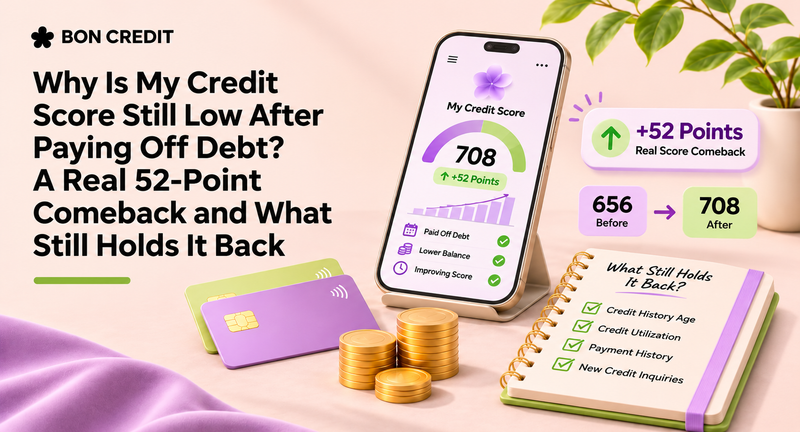
Paying down balances helps your score, but it doesn’t erase your history. Late payments and charge-offs, even on cards you’ve already closed, can generally stay on your credit report for up to seven years. They keep pulling your score down after the balances are gone. Their weight fades over time, and anything reported incorrectly can be disputed and removed.
That’s exactly what one longtime Bon Credit user ran into.
A Real Story: Up 52 Points, Then Stuck
This user had been with Bon Credit for a while. In spring, their score peaked at 748. By early summer it had dropped about 100 points, to 650.
Then came the slow part. All summer the score sat in the 650s and 660s, barely moving, month after month.
Then, in a single month, it jumped 52 points to 705. They owed less than $300 in total. For anyone who has watched a score crawl along, that’s a big moment.
But 705 still left them about 20 points short of the next score band. With almost nothing owed, the obvious question was: what’s still holding me back?
This user is anonymous. We’ve left out names, places, lenders and anything that could identify them.
What Was Actually Holding the Score Back
Bon Credit went through the report with them. The answer wasn’t their balances. At under $300, those were already working in their favor.
The drag came from the past: old late payments and charge-offs on cards that were already closed.
That surprises a lot of people. Closing a card doesn’t close its history. If an account was paid late, or charged off before you closed it, those marks usually stay on your report long after the account is gone.
What Is a Charge-Off?
A charge-off happens when a lender stops expecting payment on a debt and writes it off as a loss, usually after several months of missed payments. You may still owe the money, and the debt can be sold to a collector. On your credit report, the charge-off is one of the most damaging marks you can have.
Does Paying Off a Charge-Off Remove It?
Usually not. Paying it typically changes the status to “paid” or “settled,” which looks better to future lenders reading the report. The charge-off itself usually stays until it ages off.
How Long Do Late Payments and Charge-Offs Stay on a Credit Report?
In general, both can stay for up to seven years. For a charge-off, that clock usually starts from the date the account first went delinquent, not the date it was charged off or paid.
The good news is that their effect isn’t constant. A late payment from five years ago hurts much less than one from last year. As the marks age and new on-time history builds on top of them, the score tends to recover. That’s part of what was happening in this user’s climb.
Understanding how to improve your credit score can help you focus on other important factors, including payment history, credit utilization, and credit age.
So if your score is stuck after you’ve paid things down, the honest answer is often time plus clean payments from here on, along with making sure everything on the report is actually correct.
How to Dispute Errors on Your Credit Report
Not every negative mark is accurate. Late payments get reported on the wrong account, closed accounts show the wrong status, and charge-offs sometimes stay past the date they should have dropped off. You have the right to dispute anything that’s wrong.
Bon Credit walked this user through the steps:
Get your reports from all three bureaus. Equifax, Experian and TransUnion each keep their own report, and they don’t always match. You can get free copies at AnnualCreditReport.com.
Check every negative item line by line. Confirm the account is yours, the dates are right, the balance and status are correct, and the item hasn’t outlived the reporting window.
File a dispute with each bureau that shows the error. You can usually do this online. Be specific about what’s wrong, and attach proof like statements, payment confirmations or settlement letters.
Dispute with the lender too, if needed. The company that reported the information can correct it at the source.
Watch for the result. Bureaus generally have about 30 days to investigate. If the item can’t be verified or is found to be wrong, it must be corrected or removed.
One important limit: you can only remove information that’s inaccurate or unverifiable. Accurate late payments and charge-offs can’t be disputed away, and be wary of any company that promises otherwise.
Then, a $0.64 Bank Balance and a Payday Loan Search
A few days after the good news, things looked very different. The user’s linked bank account showed $0.64. They typed a payday lender’s name into Bon Credit.
It’s a moment plenty of people know: a strong score on paper and nothing in the account to get through the week.
Bon Credit didn’t lecture. It laid out the facts. Payday loans and car title loans often carry APRs in the hundreds of percent. A title loan also puts your car on the line. Miss the payment and the lender can take it.
Then it offered cheaper options to look at instead.
What to Consider Before a Payday or Title Loan
If you’re short on cash, a few options are usually worth checking first:
Payday alternative loans from credit unions. Many federal credit unions offer small, short-term loans with capped rates.
Asking for more time. Some lenders and utility companies offer payment extensions or hardship plans if you ask before the due date.
Lower-cost cash advances. Some apps and employers offer advances on pay you’ve already earned, often at far lower cost than a payday loan.
Local assistance programs. Community organizations sometimes help with rent, utilities or food during a gap.
Before borrowing, it also helps to compare emergency cash options, including cash advances, personal loans, and credit cards, to understand their fees, interest rates, and total costs.
A 52-point climb takes months. One expensive loan that goes wrong can undo it much faster.
What This Story Shows
A score that’s “stuck” isn’t always about what you owe today. In this case the balances were nearly zero. What held the score back was history: old late payments and charge-offs on closed cards.
The way forward has three parts: keep paying on time, let old marks age, and dispute anything that’s wrong. Just as important, avoid new damage when money gets tight.
Using credit score monitoring can also help you track changes, understand what affects your score, and identify potential issues before they become bigger problems.
Track Your Score With Bon Credit
Bon Credit’s AI agent for credit monitors your credit score, explains what’s helping and hurting it, and helps you identify steps to build better credit. Bon Credit can also help you explore lower-cost financial options when money gets tight. It’s free to start.
Frequently Asked Questions
Why is my credit score still low after paying off debt?
Your balances may be fine, but older negative marks like late payments, charge-offs or collections can still weigh on your score. They usually stay on your report for up to seven years, and their impact shrinks as they age.
How long do late payments stay on a credit report?
Generally up to seven years from the date of the late payment. Their effect on your score lessens over time, especially as you build new on-time history.
How do I dispute a charge-off?
Get your reports from all three bureaus, check the charge-off’s dates, balance and status, and file a dispute with each bureau showing an error. Include supporting documents. Only inaccurate or unverifiable items can be removed.
Does closing a credit card remove its late payments?
No. A closed account’s history, including late payments and charge-offs, usually stays on your report until it ages off.
Is a payday loan bad for my credit?
The bigger risk is cost. Payday and title loans often carry APRs in the hundreds of percent, and a title loan can cost you your car. If the loan goes to collections, that can hurt your credit too.

Samder Khangarot
Samder Khangarot is the CEO and co-founder of Bon Credit, a free AI that helps people find money, pay off debt, and build credit. He is a Stanford Graduate School of Business alum.