Unexpected Expenses: How to Prepare Yourself (Even for the Small Ones)
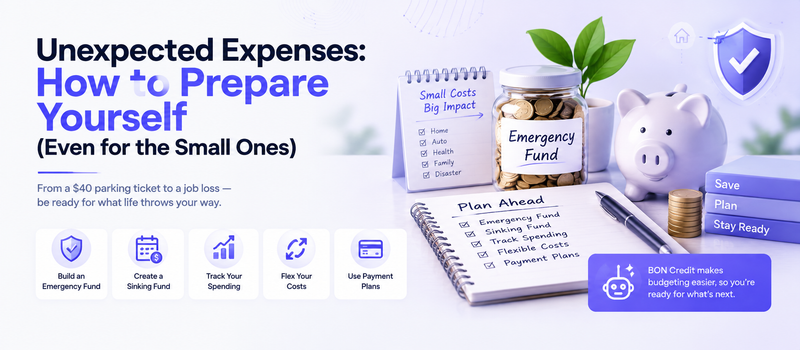
Help paycheck-to-paycheck readers see that "unexpected expenses" range from minor to severe, and give them practical steps (emergency fund, sinking fund, tracking, flexing costs, payment plans) to prepare for the full range before a small surprise becomes a real crisis, while naturally positioning BON Credit as the tool that makes that prep easier. Optimized to rank in search and be easily cited by AI search tools.
Key Takeaways
Unexpected expenses are any costs outside your normal monthly budget, from a $40 parking ticket to a job loss.
There's a real difference between minor vs. major unexpected expenses, one is annoying, the other can threaten your stability.
A sinking fund and an emergency fund solve different problems. Confusing them is why "surprise" costs keep draining your savings.
Tracking spending is the foundation that makes every other budgeting tip possible.
BON Credit helps automate the parts most people struggle to keep up with by hand.
Nobody plans for a flat tire on a Tuesday morning. Or a $300 vet bill the same week rent is due. These moments aren't rare, they're just unpredictable, and that's what makes them hard to plan for.
Almost half of Americans say they're living paycheck to paycheck in 2026, according to Debt.com. That means a huge number of people have almost no room to absorb even a small surprise cost without it throwing off the rest of the month.
This guide breaks down what unexpected expenses actually are, the most common ones people run into, and five practical ways to prepare so a surprise bill doesn't turn into a real crisis.
What Are Unexpected Expenses?
So what are unexpected expenses, exactly? Any cost that falls outside your regular monthly budget, no matter the size.
That's a wide net. A $60 parking ticket and a sudden layoff both technically count. But only one of those puts your basic stability at risk.
That's the distinction worth understanding early: not every unexpected cost is a financial emergency. It becomes one when the amount is large enough, or your income disrupted enough, that it threatens rent, food, or other essentials. This article covers the full range. For the severe end specifically, our guide on what a financial emergency looks like goes deeper.
Common Unexpected Expenses Examples
Here are some real-world unexpected expenses examples, grouped by category, each running from minor to severe.
Household costs. A broken appliance or a small plumbing leak on one end. A failed furnace in January or storm damage on the other. This is where a sinking fund earns its keep, money set aside ahead of time for costs that are irregular but predictable, like insurance premiums or annual maintenance. That's different from an emergency fund, which is for things you genuinely can't see coming.
Auto costs. A flat tire or a parking ticket are minor annoyances. A blown transmission is not. The average car repair hit $838 in 2026, up roughly a third since 2021, according to the Bureau of Labor Statistics.
Medical costs. An urgent care copay is manageable. Emergency surgery or a major diagnosis is a different category entirely, and often crosses into what we'd call a financial emergency.
Employment disruptions. A slow freelance month is inconvenient. A full layoff is something else. With so many households living paycheck to paycheck, even a short gap in income can be hard to absorb.
Family and personal costs. An unplanned school fee or a vet bill sits at the small end. A funeral or urgent legal costs sit at the other.
Natural disaster costs. Storm, flood, or fire damage, plus the cost of temporary displacement. Worth noting: many standard insurance policies exclude specific risks like flood, so check your coverage before you assume you're protected.
How to Prepare for Unexpected Expenses: 5 Tips
Here's how to prepare for unexpected expenses without overhauling your entire budget.
1. Build an emergency fund. Aim for three to six months of essential expenses, based on your core needs like housing, food, and utilities, not your total spending. This is your buffer for the truly unpredictable.
2. Start a sinking fund for costs you can see coming. Car registration, annual subscriptions, holiday spending. These aren't unexpected, but they get treated that way every time they land, quietly draining the fund meant for real emergencies. A small separate category fixes that.
3. Know which expenses can flex. Understanding which costs are fixed and which are variable determines how fast you can absorb a surprise. Fixed costs like rent don't move. Variable ones like dining out or subscriptions can be cut temporarily.
4. Ask about a payment plan before you panic-pay. Many medical providers and some billers offer zero-interest payment plans if you ask early, before the bill goes to collections. Short-term credit can bridge a real gap, but treat it as a last resort. The interest works against the same goal your emergency fund is trying to protect.
5. Track your spending. A 2026 survey from West Monroe found 89% of people underestimate their own spending. Without accurate numbers, you can't know what's actually available to redirect. This is the tip that makes the other four possible.
Together, this is basically how to plan for unexpected expenses: know your numbers, separate your funds by purpose, and build in flexibility before you need it.
How BON Credit Can Help With Budgeting for Unexpected Expenses
This is exactly what helps you prepare for unexpected expenses: seeing them coming, or being able to absorb them fast, instead of getting caught off guard.
BON Credit tracks your spending by category in real time, so you can quickly see which areas have slack to flex and build both an emergency fund and a sinking fund without doing it all by hand. Money the app finds elsewhere, forgotten subscriptions, refunds, duplicate charges, can be routed straight into either fund automatically. It's free to use for core budgeting, connects to your bank through a read-only link, and surfaces missed money without any extra effort on your part.
If you're serious about budgeting for unexpected expenses, our AI powered financial assistant is built to handle the tracking so you don't have to.
FAQ
How much money should I set aside to cover unexpected expenses?
Most people aim for three to six months of essential costs in an emergency fund. If that feels out of reach, start with one month and build from there. Even a small cushion changes how a surprise expense feels.
How do I deal with unexpected expenses when I don't have savings yet?
Look at what's flexible in your current budget first. Then ask whoever's billing you about a payment plan before reaching for a credit card. Start a small sinking fund the same month, even $20, so this is less likely to happen again.
What's the difference between a sinking fund and an emergency fund?
A sinking fund covers costs you know are coming, just not exactly when, like car registration. An emergency fund covers the stuff you can't predict at all, like a job loss.
Are rainy day expenses the same as emergencies?
Not quite. Rainy day expenses tend to be smaller, one-off surprise costs. A true emergency usually threatens your ability to cover rent or basic needs.
Final Thought
Unexpected expenses aren't all the same size, and treating them that way is what trips people up. Preparing for the full range, not just worst-case scenarios, is what actually keeps small surprise costs from becoming real emergencies. An emergency fund for the unplannable, a sinking fund for the foreseeable, and a clear picture of what can flex go a long way toward making the next surprise a lot less stressful.

Samder Khangarot
Samder Khangarot is the CEO and co-founder of Bon Credit, a free AI that helps people find money, pay off debt, and build credit. He is a Stanford Graduate School of Business alum.