Is a Debt Consolidation Loan Worth It? One Offer Would Have Cost $1,650 More Than Paying the Cards Directly
A debt consolidation loan is worth it only if it costs you less than the debt you already have. That means a lower APR than your cards, low or no fees, no valuable property put up as collateral, and a total repayment cost you can see in writing. If any of those are missing, paying your cards down directly can be cheaper and safer.
One Bon Credit user found that out the hard way, and almost the expensive way.
A Real Story: The $14,000 Offer
A new Bon Credit user came to us with about $8,600 on their credit cards and a loan offer for $14,000. One monthly payment instead of several card bills. On the surface, it looked like the responsible thing to do.
Before signing, they uploaded the offer to Bon Credit one page at a time and asked a simple question: is this a good deal?
It wasn’t. Here’s what the fine print showed, how the numbers compared, and the five questions you can use to check any loan offer yourself.
This user is anonymous. We’ve left out names, lenders and anything that could identify them.
The Offer as Pitched
The first page of a loan offer is written to get a yes. This one led with the loan amount and the relief of a single payment. For someone juggling several cards each month, that’s appealing.
There was already one detail worth questioning. The user owed about $8,600, but the loan was for $14,000. That’s roughly $5,400 more than the debt, and every extra dollar borrowed carries interest.
Borrowing more than you owe isn’t always wrong. But it’s a clear signal to slow down, explore your debt consolidation options, and read everything after the headline number.
Three Things Buried on Page Two
Bon Credit read the document line by line. Three details the pitch didn’t lead with changed the whole picture.
1. The Car Was the Collateral
This was a secured personal loan, backed by the user’s car. Credit card debt is unsecured. If you fall behind on a card, your credit takes a hit and the calls start, but the card issuer generally cannot repossess your car simply because you missed a payment. Other collection actions, including lawsuits, may still be possible.
Move that same debt into a loan using your car as collateral, and missed payments can put the car itself at risk. For most people, the car is how they get to work, and work is how they pay everything else.
2. The APR Was 30%
Consolidation is supposed to swap expensive debt for cheaper debt. A 30% APR is not cheap. If the new rate isn’t clearly lower than what your cards charge, you aren’t really saving money by consolidating. You’re just moving the debt and potentially paying for the privilege.
Before committing, understand how to get a debt consolidation loan and compare the interest rates, repayment terms, and total borrowing costs.
3. The Fees Were $893
That’s close to $900 just to take out the loan. Fees like these are often deducted from the loan amount or added to the balance, so you may end up paying interest on them too. None of that money touches the debt you’re trying to clear.
On its own, each of these might pass for fine print. Together, they turned a “simpler payment” into a riskier and more expensive one.
Loan vs. Paying the Cards Directly: The Side-by-Side Cost
Once the terms were clear, Bon Credit compared two options: take the loan, or skip it and put the same effort into paying the cards down directly.
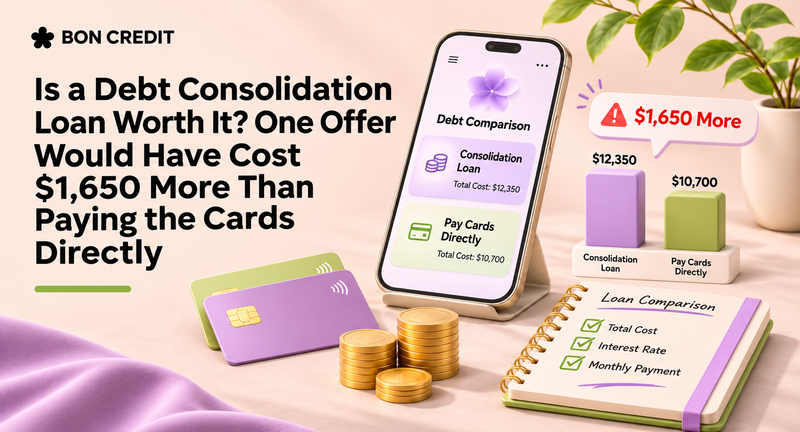
Paying the cards down directly would have cost about $1,650 less over the first six months. The car would have stayed out of it entirely.
Before choosing a repayment strategy, it helps to compare the costs of a balance transfer vs. personal loan vs. debt consolidation. Interest rates, fees, and repayment timelines can make one option significantly more expensive than another.
If you want to avoid additional borrowing, consider paying off credit card debt without a loan by using your existing income and following a structured repayment plan.
That’s why the honest answer to “is a debt consolidation loan worth it?” is: it depends on the terms. A good loan can simplify your life and save money. A bad one can leave you owing more than when you started.
Why “You Don’t Have to Sign Today” Matters
Loan offers often come with urgency built in: approvals that “expire,” rates that are only held for a short time. That pressure is exactly what gets people to sign before reading page two.
Bon Credit’s first message after the comparison was simple: You don’t have to sign today.
It also pointed the user to two places for a second opinion. One was a real person to talk the situation through. The other was a nonprofit credit counselor, who can look at your whole budget and explain your options, including a structured repayment plan in some cases. Advice from someone who isn’t selling you the loan is worth a lot when your car is on the line.
The goal wasn’t to make the decision for them. It was to make sure they saw the whole deal before making it.
How to Check Any Loan Offer: 5 Questions to Ask Before You Sign
Use these five questions on any consolidation loan, personal loan or refinance offer. If you can’t get a clear written answer to all five, don’t sign yet.
Is the loan secured or unsecured? Look for words like “collateral,” “lien” or “security interest.” If your car or home backs the loan, you could lose it if you can’t pay.
What is the APR? Compare the APR, not just the monthly payment, with what your cards charge now. If it isn’t clearly lower, the loan probably won’t save you money.
What are the total fees? Add up origination, processing and document fees, plus any prepayment penalty. Ask whether they come out of the loan or get added to what you owe.
What will I pay in total? A lower monthly payment can hide a longer term and a higher overall cost. Ask for the total amount you’ll repay over the life of the loan. You can also use a credit card payoff calculator to estimate how much interest you could pay by clearing your existing balances directly.
What happens if I miss a payment? Find out about late fees, penalty rates and, for secured loans, when the lender can take the collateral.
The test takes about ten minutes. In this case, it was worth about $1,650 and a car.
When a Debt Consolidation Loan Can Make Sense
Consolidation isn’t always a bad idea. It can work well when:
The APR is meaningfully lower than your current card rates
Fees are low or zero, and you know the exact amount
The loan is unsecured, so none of your property is at risk
You borrow only what you owe, not extra
You have a plan to stop adding new balances to the cards you pay off
If an offer meets all of these, it may be worth a closer look. If it doesn’t, paying the cards down directly, starting with the highest-interest card, is often the cheaper path.
Understanding how to pay off credit card debt can also help you build a repayment strategy that reduces interest costs without taking on another loan.
Check Your Next Offer With Bon Credit
Bon Credit’s AI agent for debt payoff helps you track card balances, interest rates, and repayment options in one place. It can help you compare debt repayment strategies and understand potential interest savings before making a decision.
Frequently Asked Questions
Is a debt consolidation loan worth it if the APR is the same as my credit cards?
Usually not. Once you add fees, a loan at the same rate can cost more than the cards. Consolidation pays off when the rate is clearly lower and the fees are small.
Can a lender take my car on a debt consolidation loan?
Yes, if the loan is secured by your car. Read the offer for words like “collateral” or “lien,” and ask the lender directly before you sign.
Are debt consolidation loan fees negotiable?
Sometimes. Ask for a full fee breakdown in writing and compare it with other offers. Treat a lender that won’t explain its fees clearly as a warning sign.
What should I do if I feel pressured to sign a loan quickly?
Don’t sign under pressure. Take time to compare costs or talk to a nonprofit credit counselor before making a decision.

Samder Khangarot
Samder Khangarot is the CEO and co-founder of Bon Credit, a free AI that helps people find money, pay off debt, and build credit. He is a Stanford Graduate School of Business alum.