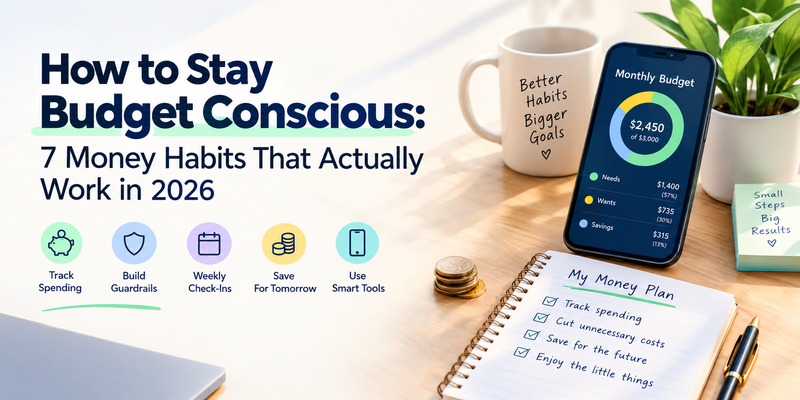
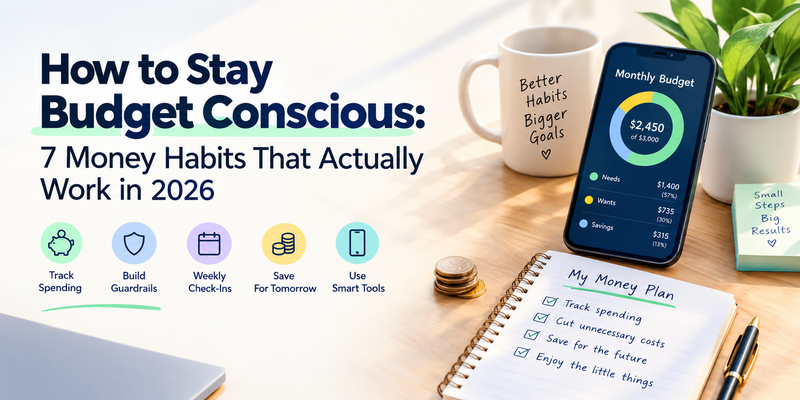
How to Stay Budget Conscious: 7 Money Habits That Actually Work in 2026
Your paycheck hits on Friday. By the following Wednesday, you're checking your balance and wondering where half of it went. Nothing dramatic happened. No big purchase, no emergency. Just a coffee here, a delivery order there, and three "pay in 4" checkouts that felt like nothing at the time.
That's the 2026 money problem. Spending has never been easier, and tracking it has never felt harder.
Being budget conscious means making intentional spending choices so your essentials are covered and your savings actually grow, without living in constant restriction mode. It's not about cutting out every small joy. It's about knowing where your money goes before it's gone. In 2026, that's gotten harder because one-tap checkouts and Buy Now, Pay Later plans are built to make spending feel smaller than it is.
TL;DR:
Budget conscious means intentional spending, not restriction. You cover essentials, grow savings, and still spend on things you value.
The 50/30/20 rule (needs/wants/savings) is a good starting frame, but BNPL and saved-card checkouts are the newest blind spot most guides ignore.
Weekly tracking, spending guardrails, and letting a tool flag leaks (forgotten subscriptions, refunds owed) beat willpower every time.
What Being Budget Conscious Actually Looks Like in 2026
A budget-conscious lifestyle isn't a spreadsheet you fill out once a month and forget. It's a set of small habits that keep your spending aligned with what actually matters to you. Below are seven that hold up in 2026, including the one most advice from a few years back completely misses.
1. Get an Honest Read on Where You Actually Stand
You can't manage a budget you haven't looked at. Start with three numbers: your total monthly income, your fixed bills, and your current debt balances. Not estimates. Actual numbers, pulled from your accounts.
The 50/30/20 rule is a solid lens once you have those figures. Roughly 50% goes to needs, 30% to wants, and 20% to savings and debt paydown. It's not a rigid law, but it gives you a benchmark to check yourself against.
This isn't a full financial audit. Give it 15 minutes, not a weekend.
2. Watch for Buy Now, Pay Later Creep
This is the part most budgeting advice still ignores. As of March 2026, LendingTree data shows 47% of Americans have used a Buy Now, Pay Later service, and roughly 68% of those users say it led them to spend more than they meant to.
Here's why it works that way. When a $200 purchase splits into four $50 payments, each one feels small and forgettable. Your brain stops tracking it as one purchase. Add a saved card for one-tap checkout, and the friction that used to make you pause before spending disappears entirely.
A simple fix: once a month, add up every active BNPL installment across every app and treat it as one line item, not four separate "small" payments. Seeing the real total changes how you spend next time.
3. Build Discipline With Guardrails, Not Willpower
"Just be more disciplined" isn't a plan. Discipline that depends on willpower runs out by the third week of the month, usually right when temptation shows up.
Guardrails work better because they don't ask you to resist anything. Set an automatic transfer to savings on payday, before you see the money in checking. Open a separate account just for discretionary spending and cap what goes into it. When the account's empty, you're done spending for the month, no negotiation required.
4. Separate Needs From Wants Before You Separate Short-Term From Long-Term Goals
Every purchase decision starts with one question: is this a need or a want? If it's a want, add a second question: can it wait 24 to 48 hours?
That short cooling-off window matters most for bigger purchases, the exact moments when BNPL gets offered at checkout to make the decision feel easier than it should. Giving yourself a day or two to decide isn't about guilt. It's about making sure the purchase is something you actually want once the urge fades, not something you'll be paying off in installments for a purchase you barely remember.
This is what mindful spending and guilt-free spending actually mean in practice. You're not saying no to everything. You're just making the decision on purpose instead of by default.
5. Track Spending Weekly, Not Just Monthly
A monthly review tells you what already happened. A weekly one gives you time to fix it. Five minutes each Sunday, scanning what you spent, catches overspending while there's still a week left to adjust, instead of finding out on the 28th that you're already over.
If you want to go deeper on why the cadence matters this much, why tracking your expenses throughout the month matters breaks down the mechanics in more detail.
6. Keep a Real Emergency Buffer, Not an Aspirational One
Everyone knows they should have an emergency fund. Fewer people actually have 3 to 6 months of essential expenses set aside, which is the benchmark worth aiming for.
You don't need the full explanation here since a dedicated resource already covers it. If you're starting from zero, how to create an emergency fund from zero walks through the steps.
7. Let a Tool Do the Noticing For You
Manual tracking catches what you remember to write down. It misses the subscription you signed up for during a free trial eighteen months ago, the recurring charge that quietly went up, or the refund you're owed but never claimed.
Modern budgeting tools don't just log what you spent. They actively look for money you're losing without noticing, which is exactly where a habit-based approach hits its limit.
Where Willpower Runs Out, Bon Credit Notices for You
You can build every habit on this list and still miss things a human tracking spreadsheet by hand simply won't catch. That's the gap Bon Credit is built to close.
Bon Credit is a free AI-powered financial assistant that links to your accounts, builds a budget that fits your actual spending, and tracks every category in real time, so you're not the one doing the math every week.
It also goes looking for what habit #2 and #7 above point at directly. Bon Credit surfaces forgotten subscriptions and recurring charges you've stopped noticing, flags refunds you may be owed, and shows you where your BNPL payments are quietly adding up. Users have found real money this way, not hypothetical savings. One reported a better balance transfer that's expected to save over $2,000 in interest they didn't know they qualified for.
You link your accounts, Bon Credit finds what you're missing, and it tells you what to do next. Pay and manage your credit cards, budget, track spending, and catch what you're losing, all in one app.
FAQ
What does budget conscious actually mean?
It means you make spending decisions on purpose. You know your income, your bills, and your goals, and you check new purchases against them instead of spending first and checking your balance later. It doesn't mean cutting out everything you enjoy.
Is being budget conscious the same as being cheap?
No. Being cheap means avoiding spending regardless of value. Being budget conscious means spending on what matters to you and cutting back on what doesn't, which is why guilt-free spending is part of the equation, not the opposite of it.
How do I become budget conscious if I've never tracked my spending before?
Start with the 50/30/20 split on one month of real numbers. Don't aim for perfect categories on day one. Just get a baseline, then adjust weekly from there.
Does Buy Now, Pay Later ruin a budget?
Not automatically, but it makes overspending easier because the payments feel smaller and more spread out. The fix isn't avoiding BNPL entirely. It's adding up every active installment monthly so you see the real total instead of four separate "small" payments.
Can an app really replace manual budgeting?
It replaces the parts that are easy to miss by hand, like forgotten subscriptions or a refund you never claimed. The habits still matter. The tool just catches what the habits alone won't.
Small Leaks, Not Big Restrictions
Staying budget conscious in 2026 has less to do with cutting your spending to the bone and more to do with closing the leaks you can't see: BNPL installments that don't feel like real money, subscriptions you forgot you had, and impulse taps that add up faster than they seem to.
Get an honest number, build guardrails instead of relying on willpower, separate needs from wants, track weekly, keep a real emergency buffer, and let a tool catch what you can't. Seven habits, one goal: keep more of what you earn.
Ready to stop guessing where your money goes? Get the Bon Credit app and let it start finding money you didn't know you were losing.

Samder Khangarot
Samder Khangarot is the CEO and co-founder of Bon Credit, a free AI that helps people find money, pay off debt, and build credit. He is a Stanford Graduate School of Business alum.