How to Plan a Monthly Maintenance Budget
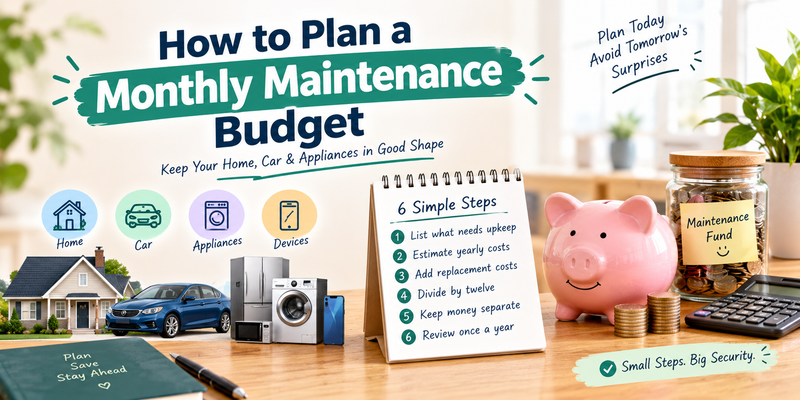
This article shows you how to estimate upkeep and repair costs for your home, car, and appliances, then turn them into a steady monthly amount you can set aside.
Key Takeaways (TL;DR)
A monthly maintenance budget sets aside money each month for upkeep and repairs you know will come.
Estimate yearly costs for your home, car, and appliances, then divide by twelve.
Common starting points: about 1% of home value a year, and AAA’s 11.04 cents per mile for car upkeep.
Keep the money separate from your emergency fund and review it once a year.
The water heater did not give a warning. It stopped on a Tuesday.
Here is how to plan a monthly maintenance budget so a day like that costs you less stress: estimate what your home, car, and appliances need each year, divide by twelve, and set that amount aside every month.
These costs are common. In the Federal Reserve’s 2025 household survey, 59% of adults had at least one major unexpected expense in the prior 12 months. The most common were a major vehicle repair or replacement (30%) and a major house or appliance repair (22%).
The timing surprises people. The category rarely should. In this guide, maintenance means upkeep and repairs on what you own: your home, your car, your appliances, and your devices.
What Is a Monthly Maintenance Budget?
A monthly maintenance budget is money you set aside each month for upkeep and repairs on things you own, such as a home, car, and appliances. You cannot predict the month a repair hits, but you can predict that repairs will come. The monthly amount spreads that cost out.
Think of it as paying a future repair bill in small pieces. When the bill arrives, the money is already there, so it does not land on a credit card or drain your savings.
How to Plan a Monthly Maintenance Budget
Plan it in six steps: list what needs upkeep, estimate each item’s yearly cost, add replacement costs, divide the total by twelve, move that amount into its own account, and review it once a year. Start with your home and car, since they usually cost the most.
Step 1: List What Wears Out
Write down what you own that needs upkeep or will need replacing. That usually means your home or roof, heating and cooling, your car, major appliances, and key devices like a laptop or phone.
Skip anything you rent where the landlord handles repairs.
Step 2: Estimate the Yearly Cost of Each Item
Use rules of thumb for the two biggest items. For a home, many housing experts suggest about 1% of its purchase price each year. For a car, AAA publishes average per-mile costs for maintenance, repair, and tires. Both are covered below.
For anything else, use your own records. Last year’s receipts beat any rule.
Step 3: Add Replacement Costs
Some items will not need repairs. They will need replacing. Divide the replacement cost by your estimate of how many years it will last.
A $900 washer you expect to last ten years adds $90 a year, or $7.50 a month.
Step 4: Divide the Total by Twelve
Add every item’s yearly figure, then divide by twelve. That result is your monthly maintenance budget.
If the number looks too high, do not shrink the estimates. Start with the home and car lines now and add the rest as your budget allows.
Step 5: Keep the Money Separate
Open a separate savings account or sub-account labeled for maintenance. Set an automatic transfer for payday.
Mixing this money into your main checking account makes it easy to spend on something else.
Step 6: Review It Once a Year
After 12 months, compare what you saved with what you spent. If you spent more than you saved, raise the monthly amount. If the balance keeps growing, lower it.
Also review after any large repair. A new roof or a replaced furnace changes the next decade’s estimate.
How Much Should a Home Maintenance Budget Be?
A common rule of thumb is about 1% of your home’s purchase price each year for maintenance and repairs. On a $300,000 home, that is $3,000 a year, or $250 a month. Older homes and homes with aging systems often need more.
Extension specialists describe this as an average over many years, not a bill you pay every year. Some years you spend little. Then a roof or furnace needs work, and the saved balance covers it. You can read the guidance on the Extension personal finance site.
Another rule uses about $1 per square foot per year. A 2,000 square foot home would be $2,000 a year. Treat both rules as starting points, then adjust for the age of your roof, heating system, and appliances.
How Much Should a Car Maintenance Budget Be?
AAA’s 2025 Your Driving Costs study puts maintenance, repair, and tires for an average new car at 11.04 cents per mile. At 12,000 miles a year, that is about $1,325 a year, or roughly $110 a month. Older vehicles may cost more.
You can find the figures in the AAA 2025 fact sheet. The number covers an average new vehicle, so your car may differ.
Compare it with your own shop receipts from the last two years. If your real spending runs higher, use the higher number.
Maintenance Budget vs Emergency Fund: What Is the Difference?
A maintenance budget covers costs you know will come, though not exactly when. An emergency fund covers costs you could not plan for, such as job loss or an urgent medical bill. Keeping them separate stops routine repairs from draining your safety net.
A Sample Monthly Maintenance Budget
A sample plan for a $300,000 home and a car driven 12,000 miles a year comes to about $400 a month. Your numbers will differ. The structure stays the same: one line per item, divided into a monthly amount.
This is an illustration, not a recommendation for your finances. For the appliance line, add each item’s cost divided by its expected life, then divide by twelve.
How to Keep Your Maintenance Budget on Track
Compare your planned amount with real spending every few months, move money only into and out of the maintenance account, and adjust the monthly amount after any large repair. Tracking is easier with a tool that records your spending for you.
Bon Credit’s AI budget planner tracks your spending automatically and builds a budget that fits your life, so you can check real repair costs against the number you planned. Credit card spend analysis shows how much of that spending goes on cards.
If a repair does end up on a credit card, the AI debt payoff planner can help you compare ways to pay it down.
Frequently Asked Questions
How much should I budget for home maintenance each month?
A common starting point is 1% of your home’s purchase price per year, divided by twelve. On a $300,000 home, that is about $250 a month. Older homes often need more.
How much should I budget for car maintenance each month?
AAA’s 2025 average for maintenance, repair, and tires on a new vehicle is 11.04 cents per mile. At 12,000 miles a year, that works out to roughly $110 a month. Older cars may cost more.
Is a maintenance budget the same as an emergency fund?
No. A maintenance budget pays for expected upkeep and replacements. An emergency fund pays for unplanned, urgent costs like job loss. Keep them in separate accounts so one does not drain the other.
Do renters need a monthly maintenance budget?
Landlords usually handle building repairs, so renters can skip the home line. Renters who own a car, appliances, or devices still benefit from setting aside money for those.
What should I do if I spend more than my maintenance budget in one month?
Pay from the maintenance account, since that is its purpose. Then raise the monthly amount if overspending keeps happening. Do not pull from your emergency fund unless the cost is a true emergency.
Start With the Two Biggest Lines
Pick your home and your car, work out the yearly figure for each, divide by twelve, and set up the transfer. You can add appliances and devices later. A plan that exists beats a perfect one you keep delaying.
Bon Credit is an AI-powered financial assistant that links your accounts, tracks your spending, and builds a budget that fits your life. It is free to download. If you have questions about how it works, contact the Bon Credit team.

Samder Khangarot
Samder Khangarot is the CEO and co-founder of Bon Credit, a free AI that helps people find money, pay off debt, and build credit. He is a Stanford Graduate School of Business alum.