Contrast the Difference Between a Financial Emergency and Nonemergency
This article shows you how to separate a true financial emergency from an expense that only feels urgent, so your savings are there when a real emergency arrives.
Key Takeaways (TL;DR)
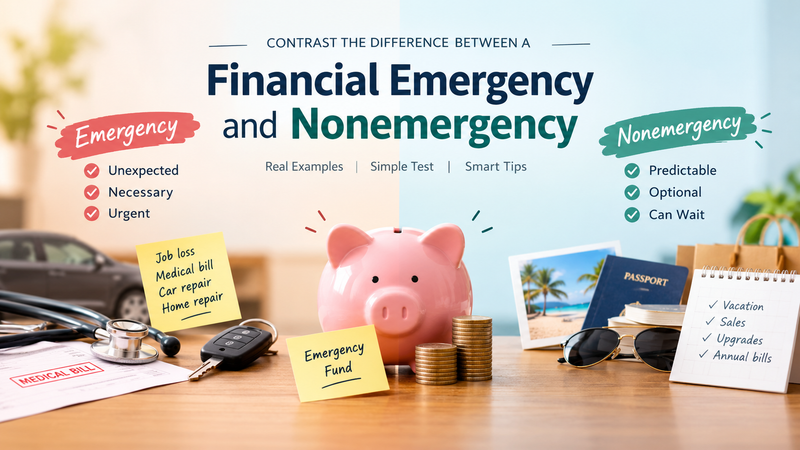
A financial emergency is unexpected, necessary, and urgent. A nonemergency fails at least one of those tests.
Job loss, urgent medical bills, and an essential car repair usually qualify. Sales, upgrades, and predictable yearly bills do not.
In the Federal Reserve's 2025 survey, 59% of adults had a major unexpected expense, and 63% said they could cover a $400 emergency with cash or its equivalent.
A common emergency fund target is three to six months of essential expenses. A fund can also grow larger than it needs to be.
A $900 car repair and a $900 weekend sale land in the same bank account, but only one of them is an emergency.
To contrast the difference between a financial emergency and nonemergency, check three things. A financial emergency is unexpected, necessary, and urgent. A nonemergency fails at least one of those tests, even when it feels pressing.
The stakes are real. In the Federal Reserve's 2025 household survey, 59% of adults had at least one major unexpected expense in the prior 12 months. Major vehicle repairs or replacements were the most common (30%), followed by major house or appliance repairs (22%) and unexpected major medical expenses (21%).
Not every cost that hits your budget belongs in that group. Spending emergency savings on a sale or an upgrade leaves less for the car, the clinic, or the landlord. This guide gives you a simple test, examples on both sides, and a way to size your emergency fund.
How Do You Contrast the Difference Between a Financial Emergency and Nonemergency?
A financial emergency is an unplanned expense you must pay to protect your health, safety, income, or housing, and it cannot wait. A nonemergency is anything you can delay, plan for, or skip without serious harm. Three tests separate them: unexpected, necessary, and urgent.
Unexpected: You did not see it coming and could not have budgeted for it in a specific month.
Necessary: Skipping it causes real harm, such as losing your job, your home, or your health.
Urgent: The deadline is days away, not months.
An expense that meets all three belongs to emergency savings. An expense that misses even one belongs in your regular budget.
Financial Emergency vs Nonemergency at a Glance
What Counts as a Financial Emergency?
A financial emergency is a sudden cost tied to your health, safety, income, or housing. Common examples of a financial emergency include job loss, an urgent medical bill, a car repair you need to get to work, and a burst pipe or failed furnace.
Job loss or a sudden drop in income. Rent, utilities, and food bills continue while pay stops.
An urgent medical or dental bill. Delaying care can make a problem worse. The Fed found that 26% of adults skipped medical expenses because of cost in the prior year.
An essential car repair. If the car is how you reach work, a breakdown threatens your income.
A home repair that affects safety or livability. A burst pipe, a failed furnace in winter, or a roof leak qualifies.
Context changes the answer. A broken-down car is an emergency if it is your only way to work. A dented bumper is not.
What Counts as a Nonemergency Expense?
A nonemergency expense is one you can plan for, delay, or decline. That includes sales, upgrades, vacations, gifts, and predictable yearly bills like insurance premiums or car registration. These costs may matter, but they are not sudden, so they belong in your budget instead of your emergency savings.
Predictable but irregular costs trip people up most. A $1,200 annual insurance premium feels like a hit, but it arrives on the same date every year. Setting aside $100 a month turns it into a planned expense.
Bon Credit's AI budget planner tracks your spending and builds a budget that fits your life, so repeating costs are easier to see and plan for.
Essential vs Discretionary Spending: Where Is the Line?
Essential spending covers what you need to live and earn income: housing, utilities, food, transportation to work, insurance, minimum debt payments, and necessary healthcare. Discretionary spending covers wants such as dining out, streaming, travel, and upgrades. Emergencies are almost always essential spending that arrives unexpectedly.
The gray zone is where mistakes happen. A phone is essential if you need it for work, but a newer model is discretionary. Groceries are essential, while a delivery fee for convenience is not.
Spending you can pause without harm is discretionary. It is also the first place to cut when an emergency drains your savings.
Is This Really an Emergency? Ask Three Questions
Ask three questions: Did this arrive unexpectedly? Would waiting cause real harm? Is the deadline days away, not months? Three yes answers point to a true emergency. Any no answer means the expense belongs in your regular budget.
Take two $600 bills. A tow and brake repair on the car you drive to work is unexpected, harmful to delay because you would miss shifts, and due now. That is an emergency.
A $600 phone upgrade because a new model launched fails all three questions. You chose it, nothing bad happens if you wait, and no deadline applies. That is a nonemergency.
For gray areas, the harm question usually settles it. Ask what specifically goes wrong if you wait a week.
How Much Emergency Fund Is Enough? Your Emergency Fund Might Be Too Big
A common target is three to six months of essential expenses, with more for variable income or a single earner. A fund beyond that range can be too big if the extra cash sits in low-interest savings while you carry high-interest credit card debt.
Start with essentials only. Add up rent or mortgage, utilities, groceries, insurance, transportation, and minimum debt payments. If that total is $3,000 a month, your target range is $9,000 to $18,000.
Now the other side. Say your fund holds $30,000 while a credit card balance charges a much higher rate than your savings earns. The interest you pay can outweigh the interest you earn. Moving part of the extra cash to the card can save money, as long as you keep your cushion.
For many households, though, the bigger risk is having too little. The Fed reports that 4 in 10 adults with incomes under $50,000 could not cover even a $100 emergency expense with savings alone. A starter cushion comes first for them.
The Bon Credit AI debt payoff planner can help you compare ways to pay down debt before you decide how much cash to redirect.
What Should You Do When a Real Emergency Hits and Savings Fall Short?
Pay the most urgent essentials first, ask creditors and providers about payment plans, and pause discretionary spending right away. Cover housing, utilities, food, and transportation to work before anything else. If you need to borrow, compare the total cost of each option before you accept one.
List what is due and when. Rank each bill by its deadline and the harm of missing it.
Pause discretionary spending. Start with recurring charges you no longer use. Bon Credit scans linked accounts for duplicate subscriptions and unused recurring payments, and its credit card subscription management feature puts them in one place.
Ask for hardship options. Some utilities, landlords, and medical providers offer payment plans or extensions, and asking early usually gives you more choices.
Compare borrowing costs. Bon Credit helps you find cash advances and lower-cost borrowing options when they make sense. Offers come from third-party partners, and approval and terms vary.
Frequently Asked Questions
Is a car repair a financial emergency?
It is if the car is your only way to reach work or handle essential trips, and the repair is needed now. Cosmetic fixes, upgrades, and repairs on a spare vehicle usually are not emergencies.
Can I use my emergency fund for a vacation or a sale?
No. A vacation or sale is planned or chosen, so it belongs in your regular budget or a separate savings goal. Using emergency savings for it leaves less cushion for a true emergency.
Is a medical bill a financial emergency?
An urgent medical bill often is, since delaying care can cause harm. Planned or elective bills usually are not. If you cannot pay in full, ask the provider about a payment plan.
Should I build an emergency fund or pay off credit card debt first?
A common approach is to build a small cushion first so one surprise does not land on the card, then pay down high-interest debt faster. The right split depends on your interest rates and income stability.
What should I do after I use my emergency fund?
Refill it. Set a small automatic transfer each payday until the balance returns to your target. Nonessential spending can wait until the fund recovers.
Treat Emergencies and Nonemergencies Differently
A true emergency is unexpected, necessary, and urgent, and it is the job of your emergency fund. Everything else, from a sale to a yearly premium, belongs in the budget. Sorting expenses into financial emergency vs nonemergency keeps your savings available for the repair, the bill, or the paycheck gap that cannot wait.
Bon Credit is an AI-powered financial assistant that links your accounts, tracks your spending, and builds a budget that fits your life. It is free to download. If you have questions about how it works, contact the Bon Credit team.

Samder Khangarot
Samder Khangarot is the CEO and co-founder of Bon Credit, a free AI that helps people find money, pay off debt, and build credit. He is a Stanford Graduate School of Business alum.