AI for Credit Card Decisions: What It Can Do, and Where It Stops
Key Takeaways
More people now ask an AI which credit card to get. It’s a fast way to build a shortlist.
Meta’s Muse Spark brings that habit into apps people already use every day, with a shopping mode built around creators and brands.
A general AI doesn’t know what you spend, what you owe or what you pay in fees. That’s where a personal finance agent helps.
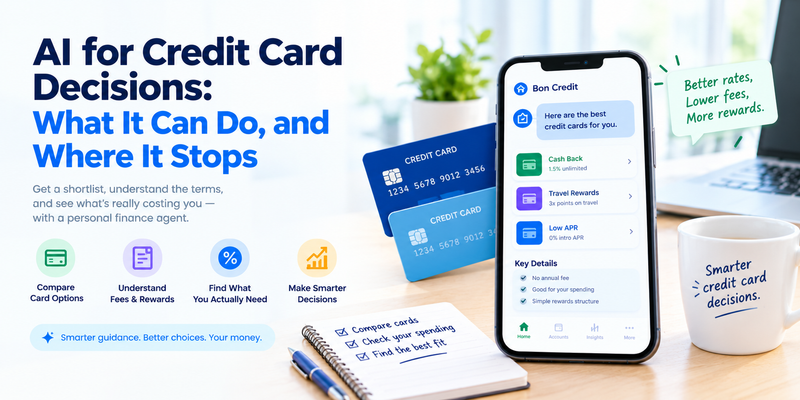
Bon Credit is a personal AI agent for credit and money. It reads your linked accounts and tells you your next move. It’s free to download and use.
Always confirm the final terms with the card issuer before you apply.
Ask a friend which credit card to get and you’ll hear about their card. Ask an AI and you’ll get a tidy list with reasons, in about five seconds.
That’s why so many people are using AI for credit card research now. It’s quick, it doesn’t push a sign-up bonus on you, and it’s happy to answer the same question five different ways.
But there’s a gap. The AI knows a lot about cards. It knows nothing about you. This post covers what AI does well, where it falls short, and how a personal agent like Bon Credit fills in the rest.
TL;DR: Use general AI to build a shortlist and understand card terms. Use a finance agent that reads your real accounts to see what’s actually costing you money. Then check the details with the issuer before you apply.
Why everyone is asking AI about credit cards
Picking a card used to mean six browser tabs and a headache. Now people describe their situation and let the AI do the first pass. Something like: “I have fair credit, I carry a balance, and I want to stop paying so much interest.”
And it’s getting easier to do. In April, Meta announced Muse Spark, the model that powers Meta AI. It started in the Meta AI app and website, with a rollout planned across WhatsApp, Instagram, Facebook and Messenger. Meta also built a shopping mode that draws on creator and brand content from its apps. So a money question can now happen in the same place you scroll your feed.
It’s free to use, too, though Meta may add rate limits.
What AI is actually good at with credit cards
Plenty, if you keep your expectations reasonable.
Building a shortlist. It can narrow a huge field to a few cards that match what you told it.
Explaining the jargon. APR, grace period, balance transfer fee, annual fee. It’ll explain each one in plain words, as many times as you need.
Comparing features. Rewards, intro offers, fees. It’s good at laying them side by side.
Helping you ask better questions. It can tell you what to look for in the fine print.
Where AI for credit card advice falls short
Here’s the part people miss.
It doesn’t know your money. A general AI can’t see your bank account, your balances or your spending. So it can tell you which card has the best grocery rewards, but not whether you spend enough on groceries to care.
The numbers can be old. Card terms change. Rewards shrink, fees move, offers expire. An AI can repeat something that was true last year.
Shopping tools are built to sell. Meta’s shopping mode is built to help you find things to buy. That’s fine for sneakers. It’s a different job from telling you to pay down a balance instead of opening another card.
Privacy is worth a second look. When Muse Spark launched, Axios noted that Meta’s privacy policy puts few limits on how the company can use data you share with its AI. That’s a good reason not to paste card numbers or your Social Security number into any chat.
Your own money tells the real story. The average card rate is close to 20%, with Bankrate putting it at 19.63% at the end of September. On a $5,000 balance at 20%, you’re paying around $83 a month in interest. A card with great rewards won’t make up for that.
Meet Bon Credit: a personal agent for your credit and money
Think of Bon Credit as Muse for credit and money. It’s a personal finance AI that works on your money instead of your errands.
Here’s how it works. You link your credit, bank accounts and cards through Plaid. Every day, Bon Credit looks for ways you can save or find more money. When it finds something, it tells you exactly what to do next.
For credit cards, that looks like this:
See where your money goes. Bon Credit tracks your spending automatically, so you know whether that rewards card is actually rewarding you.
Catch forgotten subscriptions and hidden fees. It scans your linked accounts for duplicate subscriptions, unused recurring payments and fees you didn’t notice.
Pay less interest. It helps you find better ways to pay down debt, and it can point you to options like a balance transfer when it makes sense.
Build better credit. It helps you understand what improves your score, and what doesn’t.
Find money that’s yours. It helps you search for unclaimed property and class action settlements you may qualify for.
Bon Credit is free to download and use. A quick honest note: it isn’t a lender or a bank, and it may receive compensation if you choose certain partner products. Results vary, and nothing is guaranteed.
General AI vs a personal finance agent
They work well together. Use the general AI to learn what’s out there. Use Bon Credit to find out what you actually need.
How to use AI for credit card decisions, step by step
Start with your own numbers. Before you ask any AI about cards, know what you spend, what you owe and what rate you’re paying.
Ask a general AI for a shortlist. Be specific: your credit range, whether you carry a balance, what you spend on most.
Check what you already have. Sometimes the answer is to fix the card you own, not open a new one.
Confirm everything with the issuer. Rates, fees and rewards change. The issuer’s site is the source of truth.
Keep your sensitive info out of the chat. No full card numbers, no Social Security number.
Review once a month. A quick look at your statements catches problems early.
FAQ
Can AI help me choose a credit card?
Yes, for a shortlist and for understanding features. Confirm the final terms on the issuer’s website before you apply.
Is it safe to use AI for credit card advice?
Use it for research, not final decisions. Never paste full card numbers or your Social Security number into a chat.
What is Meta Muse Spark?
It’s the AI model that powers Meta AI. It takes text, image and voice input and replies in text, and it includes a shopping mode.
Does Bon Credit pick credit cards for me?
Bon Credit reads your linked accounts, shows where your money goes and tells you your next move. You make the decision.
Is Bon Credit free?
Yes. It’s free to download and use. Some advanced features may become part of a premium plan later.
Is my financial information safe?
Bon Credit uses bank-grade 256-bit encryption, doesn’t store your credentials on its servers and doesn’t sell your personal financial information.
The bottom line
AI can help you pick a card. It can’t tell you whether you should. For that, you need something that knows your actual money.
Start with one thing. Link an account, see what Bon Credit finds, and write down what you save. Download Bon Credit for free and let your personal AI agent for credit and money show you your next move.
Disclaimer: Bon Credit is a financial technology product, not a bank, lender, investment adviser or credit repair organization. Information provided is for informational purposes only and is not financial, legal, tax or credit advice. Results vary by individual, and savings are never guaranteed.

Samder Khangarot
Samder Khangarot is the CEO and co-founder of Bon Credit, a free AI that helps people find money, pay off debt, and build credit. He is a Stanford Graduate School of Business alum.