AI Agent for Refinance: Will It Actually Lower Your Rate?
Key Takeaways
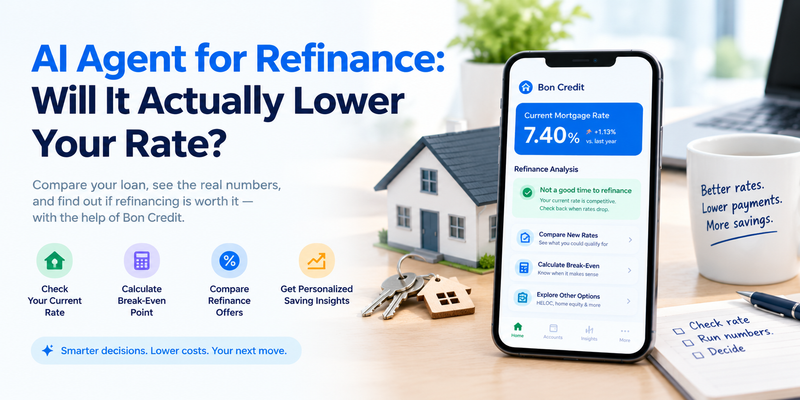
The average 30-year rate is 7.40%, up from 6.27% a year ago. For a lot of homeowners, refinancing no longer pays.
Break-even decides everything: closing costs divided by monthly savings.
Meta’s Muse is a general-purpose agent. Launch coverage doesn’t mention mortgage refinancing.
Bon Credit is a personal AI agent for credit and money. It reads your accounts and shows where interest is costing you most.
A good agent shows its math and will tell you to wait.
A year ago, the average 30-year mortgage rate was 6.27%. As of mid-October, Freddie Mac has it at 7.40%. If you bought or refinanced in the last few years, you’ve probably checked your rate more than once.
Doing that by hand gets old fast. That’s why people are looking at an AI agent for refinance: something that watches rates, knows your loan and speaks up when a switch is worth it. Meta’s Muse agent, which launched in the US in September, got a lot of people thinking about handing chores like this to an AI.
Here’s the part most articles skip. At today’s rates, the honest answer is often “wait.” A good agent says so. This guide covers the math, where Muse fits, and how a personal finance agent like Bon Credit can help you decide.
TL;DR: An AI agent for refinance compares your loan to current offers, runs the break-even math and tells you if switching saves money after costs. At 7.40%, plenty of homeowners should hold off. Check break-even first, get real quotes from lenders, and approve every step yourself.
What an AI agent for refinance actually does
It does three things. It reads your current loan, compares it with what lenders are offering, and tells you whether switching saves money once costs are counted. The better ones keep watching, so you hear about it when the numbers change.
A chatbot can explain what refinancing is. An agent works with your real balance, rate and term.
“Refinance” covers a few different moves:
Rate and term: a new rate or loan length on the same balance.
Cash out: a bigger loan that pays you the difference.
Debt refinancing: replacing credit card, auto or student loan debt with cheaper debt.
Should you refinance right now?
Probably not, if you locked in your rate a few years ago. Freddie Mac’s survey is built around home purchase loans with 20% down and excellent credit, so your own quote will differ. Treat 7.40% as a reference point, not an offer.
Most homeowners aren’t candidates at the moment. Roughly 80% of outstanding mortgages carried rates below 6% as of late 2025. Trading one of those for a 7% loan means you pay more, not less.
A refinance can still make sense if:
Your loan is adjustable and a rate reset is coming.
Your rate is well above what you’d qualify for today.
Your credit has improved since you closed. Credit score monitoring shows what moved it.
You’re carrying high-interest debt and have equity. Just know that a cash-out refinance resets your whole mortgage rate, so compare it with a home equity loan first.
The refinance math
The test is simple. Divide your closing costs by your monthly savings. That’s the number of months until you break even. Closing costs often run 2% to 6% of the loan.
Say you owe $300,000 and you’re moving from 8.00% to 7.00% on a 30-year term. Your payment drops from about $2,201 to about $1,996, a saving of roughly $205 a month. These are round numbers we ran for illustration, not a quote.
Two things can quietly change that picture. A fresh 30-year term restarts your clock, so you can end up paying more total interest even with a lower payment. And a “no closing cost” refinance usually rolls the costs into a higher rate or a bigger balance.
If you might move before the break-even month, skip it.
Where Meta’s Muse fits
Muse is Meta’s general personal agent. It can open a browser, fill out forms and work on tasks for you, and there’s a free tier with paid plans above it. In theory that could help with things like pulling statements from your email or drafting a note to a lender asking for a Loan Estimate. That’s our reading of what it can do. Launch coverage doesn’t describe a refinance feature.
The limits matter more. Lenders need credit checks, income documents and signatures that only you can give. Meta itself says Muse will sometimes get things wrong, and one bad figure on a mortgage form can delay a rate lock. Also read the data policy before you upload pay stubs or tax returns anywhere.
Bon Credit: a personal agent for your credit and money
Think of Bon Credit as Muse for credit and money. It’s a personal AI agent that works on your finances instead of your errands. You link your credit, bank accounts and cards through Plaid, it looks for ways to save every day, and when it finds something, it tells you what to do next.
For refinancing, that’s useful in a few ways:
It shows where interest costs you most. Before you chase a lower mortgage rate, it helps to know whether your mortgage, a credit card or something else is the bigger drain.
It helps you test the idea first. The AI mortgage calculator lets you try the numbers before you apply, and the AI debt payoff planner shows how different payoff strategies change your debt-free date.
It looks beyond the mortgage. Bon Credit helps you find better ways to pay down debt, and it can point you toward options like balance transfers when they make sense.
It’s free. Bon Credit is free to download and use.
One honest note. Bon Credit is not a lender, so it doesn’t replace a quote from one. It may receive compensation if you choose certain partner products, and results are never guaranteed.
Other refinances an agent can flag
Credit cards: A balance transfer card can cut your interest, though most charge a transfer fee. Run it through the balance transfer calculator first.
Auto loans: Compare your rate with current offers, and check for prepayment penalties.
Student loans: Refinancing federal loans into a private loan means giving up federal protections. You can’t undo that.
Several debts at once: Debt consolidation can simplify things. Look at total interest, not just the monthly payment.
What to check before you trust an agent
It shows its math: break-even, new term and total interest.
It compares real lender quotes, not national averages.
It asks before it submits anything.
Its data policy is clear. Look for strong encryption, a promise that your credentials aren’t stored, and a clear answer on whether your data is sold. Bon Credit uses 256-bit encryption, doesn’t store your credentials on its servers, and doesn’t sell your personal financial information.
It tells you to wait when waiting is the right call.
It doesn’t promise savings.
Agent fees look small next to closing costs. Judge any tool by the bad refinances it talks you out of, not only the good ones it finds.
FAQ
Is now a good time to refinance my mortgage?
Only if your rate is well above what you can get today. With the average near 7.40%, most homeowners with older, lower rates should stay put. Run the break-even math first.
How much does it cost to refinance?
Closing costs often run 2% to 6% of the loan. On $300,000, that’s $6,000 to $18,000.
Can an AI agent refinance my mortgage for me?
It can help with research and some paperwork. A licensed lender still issues the loan, and you sign the documents.
What credit score do I need to refinance?
Lenders set their own minimums, and higher scores get better rates. Check your score before you apply.
Is it safe to give an AI agent my financial documents?
Share only what the task needs. Find out how the agent stores data, whether you can opt out of AI training, and whether it asks before it acts.
Run the numbers first, then let an agent do the legwork
Refinancing is a math problem with paperwork attached. An agent can help with the paperwork and keep an eye on rates. It can’t turn a bad refinance into a good one.
Start with your break-even month, compare real quotes, and wait if the numbers don’t work. If you want a personal AI agent that reads your accounts and shows where interest is costing you most, download Bon Credit for free.
Disclaimer: Bon Credit is a financial technology product, not a bank, lender, investment adviser or credit repair organization. Information provided is for informational purposes only and is not financial, legal, tax or credit advice. Results vary by individual, and savings are never guaranteed.

Samder Khangarot
Samder Khangarot is the CEO and co-founder of Bon Credit, a free AI that helps people find money, pay off debt, and build credit. He is a Stanford Graduate School of Business alum.