AI Agent for Credit Building: What It Can Do for You (and What It Can’t)
Key Takeaways
An AI agent for credit building doesn’t just answer questions. It plans, tracks and reminds you, so good habits actually stick.
Meta’s Muse Spark 1.1 pushed this idea into everyday apps in July, with plans, daily briefings and email and calendar access. It isn’t built for credit, though.
Payment history (35% of a FICO score) and credit utilization (30%) matter most. Those are habits, and habits are what an agent can help with.
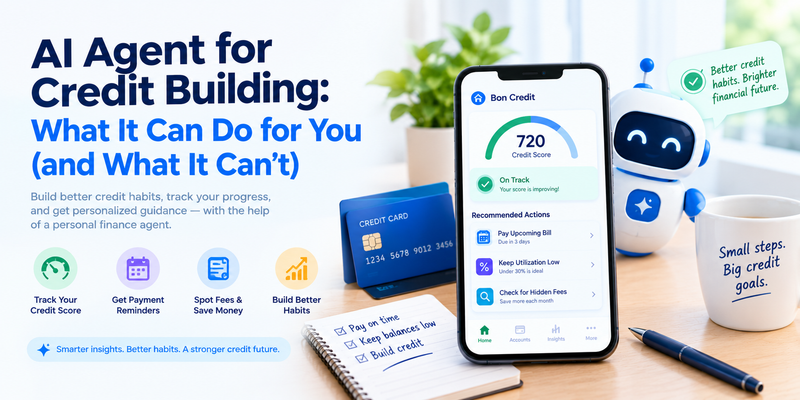
Bon Credit is a personal AI agent for credit and money. It reads your linked accounts and tells you your next move. It’s free to download and use.
No AI can build your credit for you. You still have to pay on time.
Building credit isn’t complicated. It’s just boring, and easy to forget. Pay on time, keep balances low, don’t open a pile of new accounts. Then do it again next month, and the month after that.
That’s exactly the kind of job an AI agent for credit building is good at. It doesn’t get tired, it doesn’t forget a due date, and it can spot a problem before you do.
But there’s a catch. Plenty of AI tools can chat about credit. Fewer can see your actual accounts. This post covers what an agent really does, how Meta’s latest push fits in, and where Bon Credit comes in.
TL;DR: An AI agent for credit building watches your accounts, reminds you before things go wrong and tells you what to do next. It can’t build your credit for you, but it makes the habits that do much easier to keep.
What is an AI agent for credit building?
A chatbot answers a question and stops. An agent keeps going.
In credit terms, that might mean a heads-up when a balance is getting high before your statement closes. It might be a nudge to pay a few days early, or a clear next step each week. You set it up once, and it keeps watching.
The goal isn’t to replace you. It’s to take the small, repetitive jobs off your plate so you don’t miss the ones that matter.
Why this is suddenly everywhere
In July, Meta announced that Meta AI, now powered by Muse Spark 1.1, can make plans, connect to your email and calendar apps and handle tasks for you. It can give you a daily briefing, and once you set a task up, it keeps working without being re-prompted.
That’s a big shift for everyday AI. It’s also a reminder that agents are only as useful as what they can see. Meta’s version knows your calendar and your inbox. It’s a general assistant for planning your life. It isn’t built to read your credit cards and loans.
There’s a trust question too. Tech coverage of the launch pointed out that Meta hasn’t detailed how it handles data retention and permissions when the assistant acts inside your email and calendar. Before you give any agent access to your accounts, find out what it stores and who can see it.
What actually builds credit
Before handing anything to an AI, it helps to know what moves your score. For FICO scores, the biggest pieces are:
Payment history (35%): Do you pay on time? This is the biggest factor by far.
Credit utilization (30%): How much of your available credit are you using? The common advice is to stay under 30%, and lower is better.
Length of credit history (15%): Older accounts help.
New credit and the mix of account types make up the rest. Applying for new credit creates a hard inquiry, which usually costs only a few points, but opening several accounts quickly can work against you.
If you’re starting from zero, the usual routes are a secured card, a credit-builder loan, becoming an authorized user, or rent reporting. Before you sign up for any of them, check that the lender reports to the credit bureaus. If it doesn’t, your good behavior won’t show up on your credit report.
Notice something about that list. Almost all of it is habits. That’s where an agent helps.
Where an AI agent helps (and where it doesn’t)
It helps with:
Reminding you before a payment is due
Showing your spending, so you can see whether you’re using too much of your limit
Spotting fees and recurring charges that eat into your budget
Giving you a clear next step instead of a pile of data
It can’t:
Make your payments for you without you knowing
Report your payments to the credit bureaus (only your lenders do that)
Raise your score overnight
Guarantee results
Be wary of any tool that promises to “fix your credit fast.” Real progress is slow and steady.
Meet Bon Credit: a personal agent for your credit and money
Think of Bon Credit as Muse for credit and money. Meta’s agent plans your week. Bon Credit looks after your finances.
Here’s how it works. You link your credit, bank accounts and cards through Plaid. Every day, Bon Credit looks for ways you can save money or improve your position. When it finds something worth your attention, it tells you exactly what to do next.
For credit building, that means:
Credit score monitoring. Keep an eye on your score so you can see what’s moving it.
Payment reminders. Get a nudge before a due date, not after it.
Understand what helps. Bon Credit helps you learn what improves your credit, and what doesn’t.
A budget that fits your life. Track spending automatically, so you can keep balances low without guessing.
A plan for debt. If balances are the problem, the AI debt payoff planner shows you a better way to pay them down.
Fewer money leaks. It scans for hidden fees, duplicate subscriptions and unused recurring payments, so more of your paycheck goes toward your goals.
Bon Credit is free to download and use. One honest note: it isn’t a lender, a bank or a credit repair company. It can’t build your credit for you. It helps you build the habits that do. It may also receive compensation if you choose certain partner products, and results vary.
General AI vs a personal finance agent
A simple 30-day plan
Week 1: Link your accounts and see where you stand. Write down your balances and your due dates.
Week 2: Turn on payment reminders. Set autopay for at least the minimum, so you never miss one.
Week 3: Check your utilization. If a card is near its limit, pay it down before the statement closes.
Week 4: Review what you found. Cancel anything you don’t use, and decide on one next step.
Then repeat next month. Credit rewards consistency, not big moves.
FAQ
Can an AI agent build my credit for me?
Not by itself. It can help you plan, set reminders and watch your spending. Your credit still depends on what you do, like paying on time and keeping balances low.
How long does it take to build credit?
It depends on where you’re starting. Many people see changes within a few months, but it takes longer to build a strong history. Results vary.
What affects my credit score the most?
Payment history is the biggest factor, followed by credit utilization.
Is it safe to let an AI agent see my accounts?
Check what access it asks for and why. Stick with tools you trust, and never share your full card numbers or Social Security number in a chat. Bon Credit uses bank-grade 256-bit encryption, doesn’t store your credentials on its servers and doesn’t sell your personal financial information.
Do I need to link my bank account?
Yes, to get automatic insights and recommendations. The connection runs through Plaid.
Is Bon Credit free?
Yes. It’s free to download and use. Some advanced features may become part of a premium plan later.
Start small
You don’t need a perfect plan. You need a few good habits and something that keeps you on track.
Link one account, turn on payment reminders and see what Bon Credit finds. Download Bon Credit for free and let your personal AI agent for credit and money show you your next move.
Disclaimer: Bon Credit is a financial technology product, not a bank, lender, investment adviser or credit repair organization. Information provided is for informational purposes only and is not financial, legal, tax or credit advice. Results vary by individual, and credit improvement is never guaranteed.

Samder Khangarot
Samder Khangarot is the CEO and co-founder of Bon Credit, a free AI that helps people find money, pay off debt, and build credit. He is a Stanford Graduate School of Business alum.