4 Components of a Budget: What They Are and Why They Matter in 2026
Payday lands on Friday. By the following Thursday, your balance looks thin and you can’t say where the money went.
Many households are in the same spot. The Federal Reserve’s 2025 household survey, released in May 2026, found that 63% of adults could cover a surprise $400 expense with cash or its equivalent. That leaves more than a third who could not.
Income is rarely the whole story. Often the gap comes from not knowing the 4 components of a budget and how they work together. Once you see them, the leak gets easy to find.
This guide explains each part in plain words, with simple numbers you can copy. It also shows where Bon Credit fits in, since our AI tracks your spending and finds forgotten charges for you.
Key Takeaways
The 4 components of a budget are net income, fixed expenses, variable expenses, and savings.
Net income is your take-home pay. Every other number is built on it.
Fixed expenses stay the same each month. Variable expenses change, so they need a cap.
Pay savings first, not last.
Subscription creep and unused subscriptions quietly drain cash, so check them monthly.
What Are the 4 Components of a Budget?
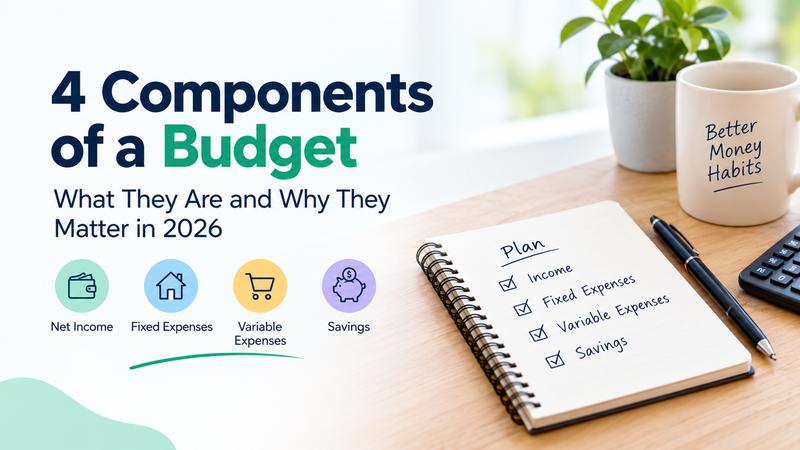
A budget has four parts: net income, fixed expenses, variable expenses, and savings. Each of the components of a budget has its own job.
Net income: the money you take home.
Fixed expenses: bills that stay the same.
Variable expenses: costs that change from month to month.
Savings: money you set aside for later.
Income comes in. The other three decide where it goes. Leave one out and the plan breaks the first time the car needs a repair.
What Is the First Component of a Budget?
The first component of a budget is net income. It is the pay that reaches your bank account after taxes and deductions.
Use this number, not your salary. Many people budget from their salary and end up short, because taxes, health premiums, and retirement contributions come out before you see a dollar.
If you earn $5,000 a month before taxes and $4,000 lands in your account, your budget starts at $4,000. If your pay changes each month, add up the last six months and use the lowest one. That keeps you from spending money that may not show up.
We will use $4,000 as the example for the rest of this guide.
How Do Fixed Expenses Work?
Fixed expenses are bills that stay about the same every month. You know the amount before the bill arrives, so they are easy to plan for.
Here is a typical set:
Rent: $1,400
Car payment: $300
Insurance: $150
Phone and internet: $150
That adds up to $2,000, or half of the $4,000 take-home pay. These costs feel locked in, but they are not. One call to your insurer or a switch to a cheaper phone plan can save money every month after.
Why Do Variable Expenses Cause Most Budget Problems?
Variable expenses change from month to month. Groceries, gas, eating out, and shopping all fall here.
They cause trouble because nothing stops you at a set amount. A bill has a due date and a price. A dinner out does not. Fixed bills get paid on autopilot, so variable spending is the only part that needs your attention.
Give each category a monthly cap. In our example, $1,200 could cover groceries ($550), gas ($150), eating out ($200), and everything else ($300).
Check your spending once a week, not once a month. An overspend you catch after seven days is easy to fix. One you catch after thirty is not.
What Is Subscription Creep and How Does It Hurt Your Budget?
Subscription creep is when small monthly charges pile up until they take a real bite out of your income. Most of the damage comes from unused subscriptions, the ones you forgot you had.
Take four charges: streaming at $15, a music app at $11, cloud storage at $10, and a fitness app at $10. That is $46 a month, or $552 a year, for things you may not even open.
Subscriptions sit inside your fixed or variable lines, which is why they hide so well. Scan your last three months of statements and cancel anything you did not use. Then set a monthly reminder to do it again.
Bon Credit can do the scanning for you. It checks linked accounts for duplicate subscriptions and unused recurring payments. You can read more about credit card subscription management on our site.
How Much Should You Save, and Why Does It Matter in 2026?
Many people aim to save 10% to 20% of net income. If that feels like too much, start at 5% and raise it every few months.
Pay savings first. Move the money the day you get paid so it never sits in checking, waiting to be spent. Build a small emergency fund first, even $500 to $1,000. Then work toward one month of costs, and later three.
Prices and interest rates keep moving. A budget you can adjust matters more than a perfect one. Even a small cushion keeps a surprise bill off your credit card. If you already carry card debt, the AI debt payoff planner can show you faster ways out.
Here is how the example adds up:
Net income: $4,000
Fixed expenses: $2,000
Variable expenses: $1,200
Savings: $800
Put the 4 components of a budget side by side and income minus the other three should land at zero. Every dollar has a job. The AI budget planner can build this for you from your linked accounts.
FAQ
What are the components of a budget?
Net income, fixed expenses, variable expenses, and savings. Income is what comes in. The other three are where it goes.
Is rent a fixed or variable expense?
Fixed. The amount stays the same each month, so you can plan for it.
What should I cut first when money is tight?
Start with unused subscriptions. You will barely notice them gone. Then trim variable expenses like eating out.
How often should I review my budget?
Do a quick check every week and a full review once a month. Bills and prices change, and your budget should keep up.
Does Bon Credit cost anything?
No. Bon Credit is free to download and use. Some advanced features may become part of a premium plan later.
Ready to Make Your Budget Work?
A budget does not need to be complicated. It needs to be honest. Know your net income, list your fixed and variable costs, cancel what you don’t use, and move savings first. That is all the 4 components of a budget ask of you. Do it this weekend. It takes about an hour, and your next payday will look different.
Download the free Bon Credit app, link your accounts, and let it track your spending, flag forgotten charges, and tell you your next move.

Samder Khangarot
Samder Khangarot is the CEO and co-founder of Bon Credit, a free AI that helps people find money, pay off debt, and build credit. He is a Stanford Graduate School of Business alum.